

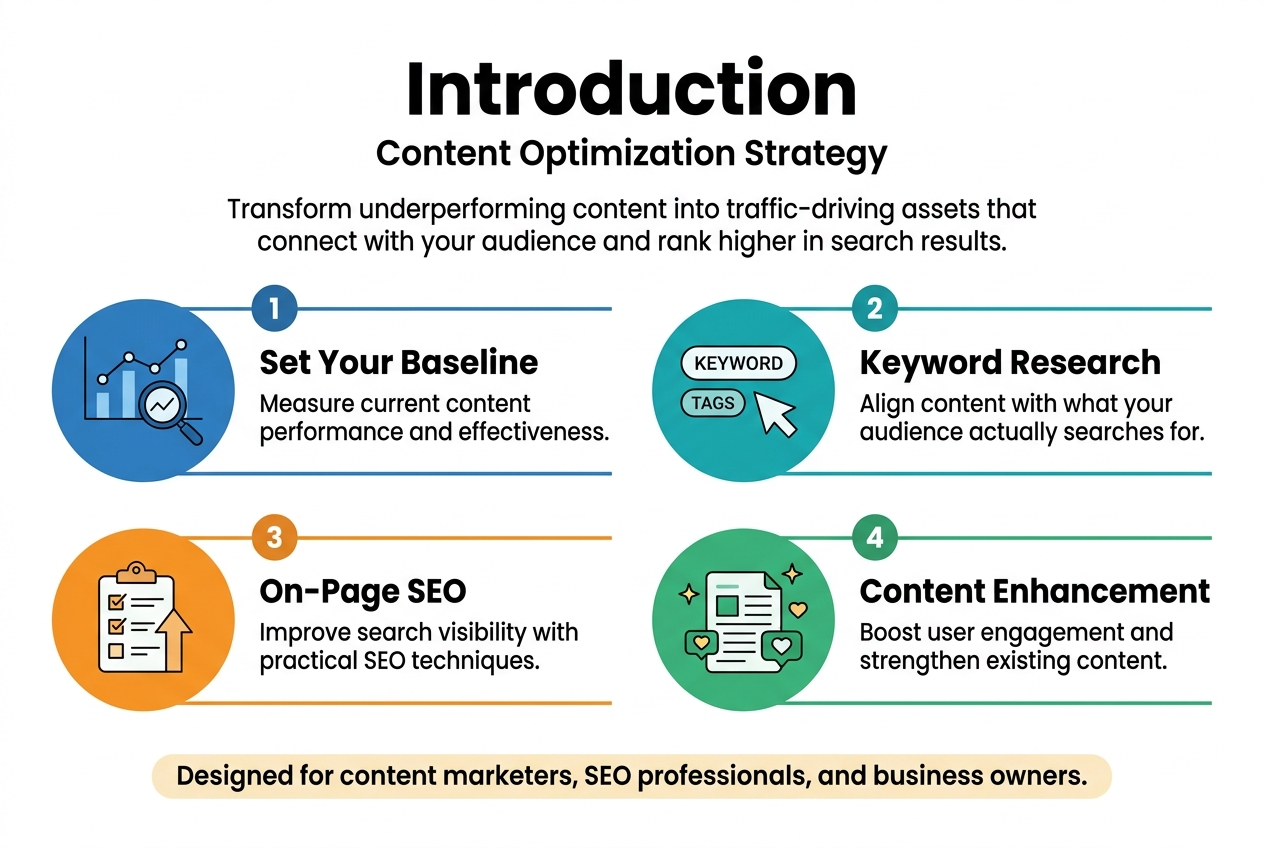
A content optimization strategy helps you transform underperforming content into traffic-driving assets that connect with your audience and rank higher in search results. This guide is designed for content marketers, SEO professionals, and business owners who want to maximize their existing content’s impact without starting from scratch.
You’ll discover how to establish a solid performance baseline to measure your current content’s effectiveness. We’ll also explore proven keyword research methods that align your content with what your audience actually searches for. Finally, you’ll learn practical on-page SEO techniques and content enhancement strategies that boost both search visibility and user engagement. Related Article
Understanding Your Content Performance Baseline
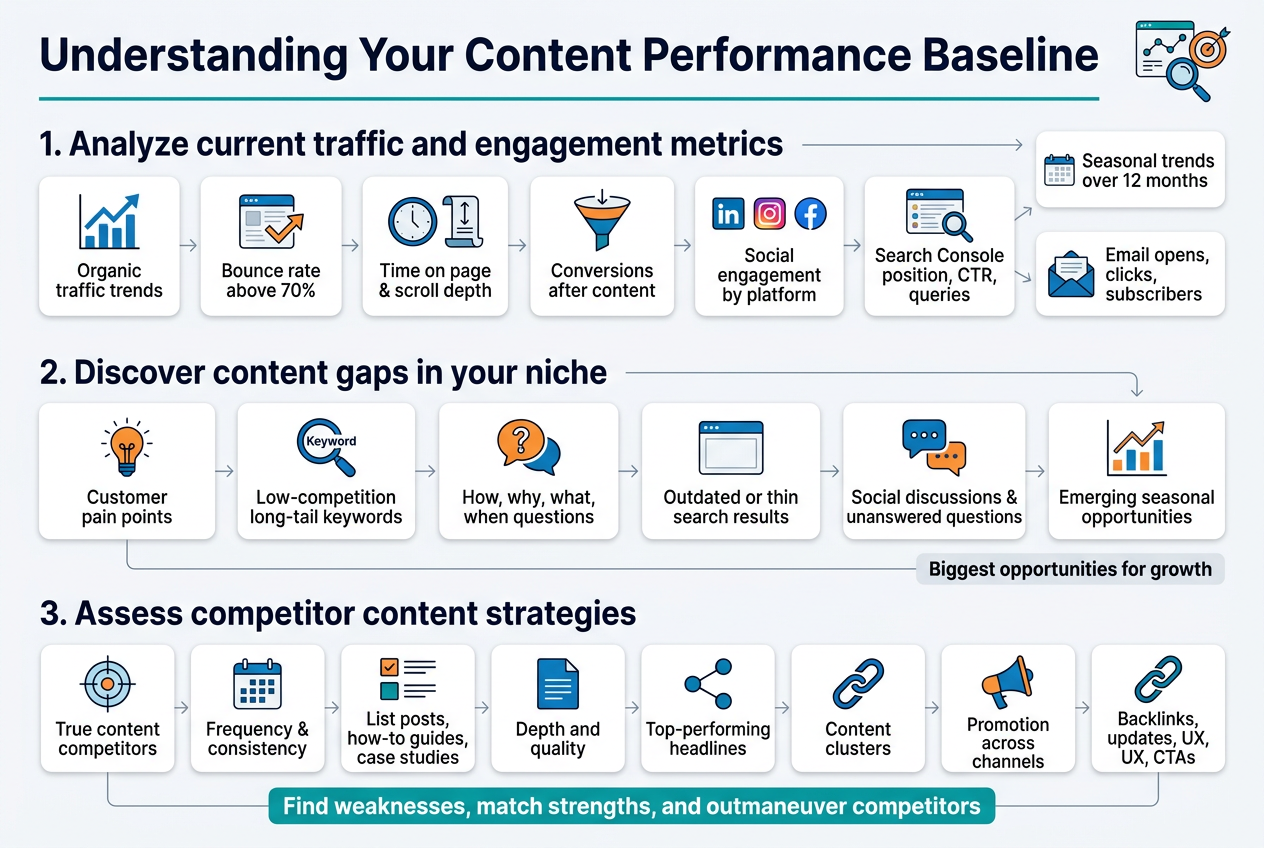
Analyze current traffic and engagement metrics
Before you can improve your content strategy, you need to know where you currently stand. Think of this as taking a health checkup for your website – you can’t treat what you don’t measure. Your current performance data tells the story of what’s working, what’s falling flat, and where the biggest opportunities lie hidden.
Start by diving into your Google Analytics data. Look at your organic traffic trends over the past 12 months. Are you seeing steady growth, decline, or frustrating stagnation? Pay close attention to your most visited pages and identify patterns. Which pieces of content consistently drive traffic? What topics resonate most with your audience?
Your bounce rate reveals crucial insights about content quality and relevance. Pages with bounce rates above 70% typically signal a mismatch between what visitors expect and what they find. High bounce rates often point to weak headlines, poor content structure, or failure to deliver on the promise that brought visitors to your page.
Time on page and scroll depth metrics show how engaging your content really is. If visitors spend less than 30 seconds on your blog posts, you’re likely dealing with content that doesn’t grab attention or provide immediate value. Tools like Hotjar or Crazy Egg can show you exactly where people stop reading, giving you precise data about content weaknesses.
Don’t overlook your conversion metrics. Track how many visitors take desired actions after consuming your content – whether that’s signing up for newsletters, downloading resources, or making purchases. Content that drives traffic but fails to convert needs serious optimization.
Examine your social media engagement rates across different platforms. Content that performs well on LinkedIn might bomb on Instagram, and vice versa. This data helps you understand which content formats and topics work best for each channel in your distribution strategy.
Search Console data provides another layer of insight. Look at your average position for different keywords, click-through rates from search results, and which queries bring visitors to your site. Pages ranking on page two or three of search results represent low-hanging fruit for optimization efforts.
Pay attention to seasonal trends in your data. Many businesses see predictable fluctuations based on holidays, industry cycles, or changing consumer behavior throughout the year. Understanding these patterns helps you plan content calendar optimization and resource allocation.
Your email marketing metrics also contribute to the baseline picture. Which blog posts generate the most email subscribers? What content topics drive the highest open and click rates in your newsletters? This data reveals what your audience truly values beyond vanity metrics.
Discover content gaps in your niche
Content gaps represent your biggest opportunities for growth. These are topics your target audience desperately wants to learn about, but quality content addressing these needs simply doesn’t exist yet – or your competitors are doing a poor job covering them.
Start your gap analysis by creating a comprehensive list of topics your ideal customers care about. Interview your sales team to understand the questions prospects ask most frequently. Customer service logs provide goldmine insights into problems people struggle with. These real-world pain points often translate into high-performing content opportunities.
Use keyword research tools like Ahrefs, SEMrush, or Ubersuggest to identify search terms with decent volume but relatively low competition. Look for long-tail keywords that signal specific intent – these often represent content gaps worth filling. Search terms with question words like “how,” “why,” “what,” and “when” typically indicate informational content opportunities.
Analyze the search results for your target keywords. If the first page shows mostly outdated content, thin articles, or pieces that don’t fully answer the search intent, you’ve found a content gap. Sometimes established websites rank well simply because they’ve been around longer, not because their content is superior.
Social media platforms reveal content gaps through the questions people ask and the discussions they start. Join Facebook groups, LinkedIn communities, Reddit forums, and Twitter conversations where your target audience hangs out. Pay attention to repeatedly asked questions and complaints about existing resources.
Google’s “People Also Ask” section provides direct insight into related questions searchers have. These suggestions come from real search data and often reveal content angles you haven’t considered. Tools like AnswerThePublic expand on this concept by showing you hundreds of questions people ask about your topics.
Review industry reports, surveys, and studies to identify emerging trends that lack comprehensive coverage. Trade publications often highlight developing issues that businesses will soon need guidance on. Position yourself as an early authority on these topics by creating content before they become saturated.
Look at your competitors’ comment sections and social media replies. When readers consistently ask for clarification or express confusion, that signals content gaps. Even successful competitor content often leaves questions unanswered, creating opportunities for you to provide more comprehensive coverage.
Search for your target keywords on YouTube, Pinterest, and other platforms beyond Google. Different platforms reveal different content gaps. A topic might be well-covered in blog format but lack quality video content, or have great visual content but need detailed written explanations.
Examine seasonal content gaps by analyzing search trends throughout the year. Many topics spike at predictable times but lack fresh, current content. Holiday-related business advice, tax season guidance, or back-to-school content often presents recurring opportunities.
Assess competitor content strategies
Understanding your competitors’ content strategies gives you the intelligence needed to outmaneuver them. This isn’t about copying their approach – it’s about identifying weaknesses you can exploit and strengths you need to match or exceed.
Identify your true content competitors by analyzing who ranks for your target keywords, not just who you consider business competitors. Sometimes the biggest content competition comes from unexpected sources – industry publications, educational sites, or businesses in adjacent niches.
Analyze their content publishing frequency and consistency. Do they post daily, weekly, or sporadically? Consistent publishers often dominate search results simply through volume and freshness signals. If your competitors publish infrequently, consistent output could give you a significant advantage.
Study their content formats and identify patterns. Do they rely heavily on list posts, how-to guides, or case studies? Which formats get the most social shares and backlinks? Look for format gaps where you can differentiate your content through unique presentation styles.
Examine their content depth and quality objectively. Many websites rank well with thin, superficial content simply because they got there first. This presents opportunities to create more comprehensive, valuable resources that naturally attract links and social shares.
Use tools like BuzzSumo to identify their most popular content pieces. What topics generate the most engagement? Which headlines and angles resonate best with their audience? Look for patterns in their high-performing content that you can adapt for your own strategy.
Analyze their internal linking strategies and content clusters. How do they connect related pieces of content? Strong internal linking helps individual pages rank better while keeping visitors engaged longer. Identify opportunities to create better-connected content ecosystems.
Pay attention to their content promotion strategies across social media platforms. Which channels do they prioritize? What posting schedules do they follow? How do they repurpose content across different platforms? Their distribution strategy often matters as much as content quality.
Review their backlink profiles to understand what types of content attract links naturally. Do they earn links through original research, comprehensive guides, or controversial opinions? This insight helps you plan content specifically designed to attract high-quality backlinks.
Look at their content update frequency. Many successful sites regularly refresh and expand existing content rather than always creating new pieces. If competitors neglect content maintenance, you can gain advantages by keeping your content current and comprehensive.
Study their user experience design and content presentation. How do they structure long-form content? What visual elements do they use to break up text? Poor readability often undermines good content – an area where you can easily excel through better formatting and design.
Analyze their conversion optimization tactics within content. How do they capture leads? Where do they place calls-to-action? What lead magnets do they offer? Understanding their monetization strategy helps you develop more effective approaches.
Monitor their content calendar patterns to anticipate their moves. Many businesses follow predictable publishing schedules around industry events, seasons, or product launches. Knowing their timing helps you plan complementary or competing content releases strategically.
Keyword Research and Content Alignment
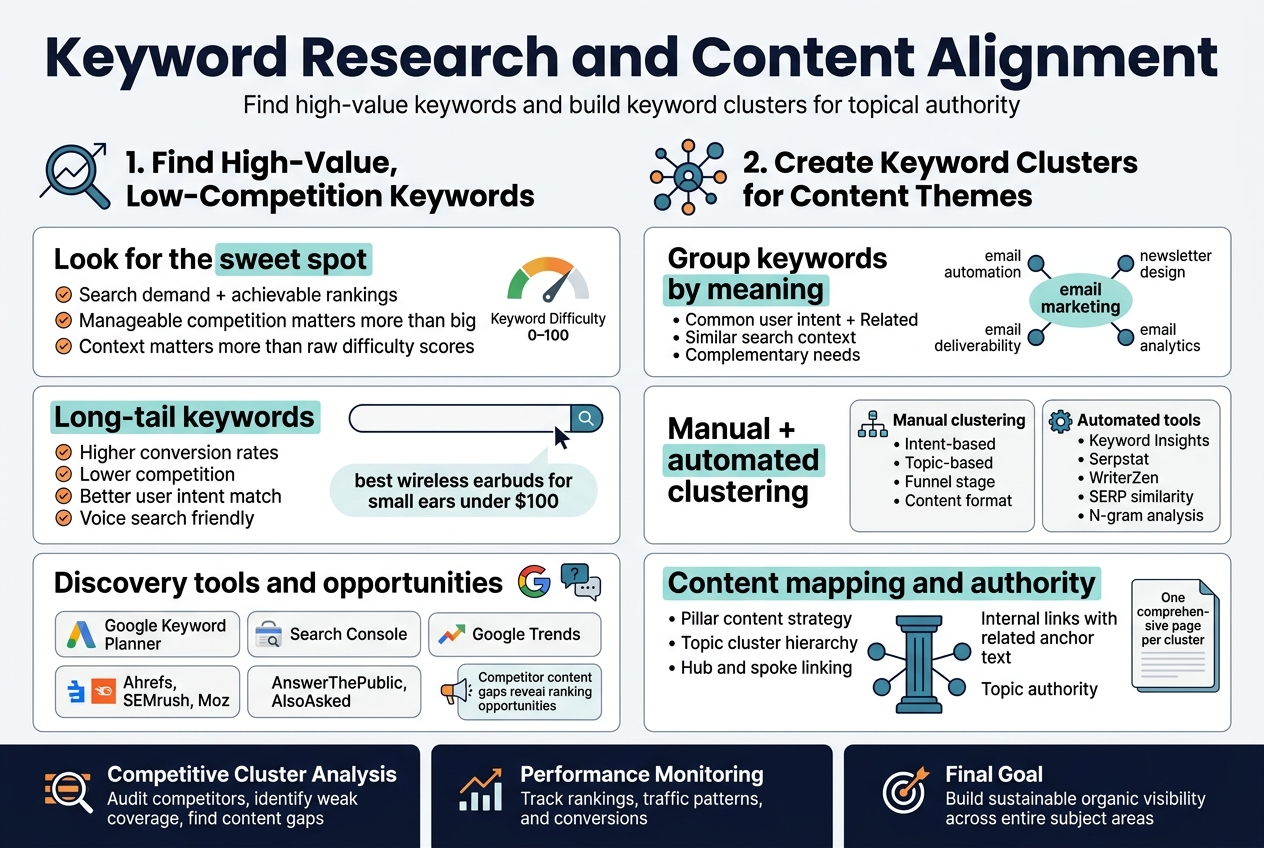
Find High-Value, Low-Competition Keywords
The heart of any successful content optimization strategy lies in discovering those golden opportunities where search demand meets achievable rankings. Finding high-value, low-competition keywords isn’t about chasing the biggest search volumes – it’s about identifying the sweet spots where your content can actually compete and win.
Search volume tells only part of the story. A keyword with 50,000 monthly searches might seem attractive until you realize you’re competing against established domains with massive authority and years of optimization behind them. Smart keyword research focuses on finding terms where the competition is manageable, the intent is clear, and the potential for ranking success is realistic.
Understanding Keyword Difficulty Metrics
Keyword difficulty scores provide a starting point, but they’re not the complete picture. These scores typically range from 0-100, with higher numbers indicating stronger competition. However, different tools calculate difficulty differently, so understanding what goes into these metrics helps you make better decisions.
Most keyword difficulty algorithms analyze factors like:
- Domain authority of ranking pages
- Page authority of individual results
- Content quality and length
- Backlink profiles
- Social signals
- User engagement metrics
A keyword with a difficulty score of 30 might be achievable for a new website in one niche but impossible in another. Context matters more than raw numbers.
Long-Tail Keywords as Your Secret Weapon
Long-tail keywords often represent the best opportunities for newer websites or those looking to expand their organic footprint. These longer, more specific phrases typically have lower search volumes but offer several advantages:
Higher Conversion Rates: Someone searching for “best wireless earbuds for small ears under $100” has much clearer purchase intent than someone searching for “earbuds.”
Lower Competition: Fewer websites optimize for these specific phrases, creating opportunities for focused content to rank well.
Better User Intent Match: Long-tail searches reveal exactly what users want, making it easier to create content that satisfies their needs.
Voice Search Optimization: As voice search grows, people use more conversational, long-tail phrases when speaking to their devices.
Tools and Techniques for Keyword Discovery
Effective keyword research combines multiple tools and approaches to uncover opportunities others might miss.
Google’s Own Tools: Start with Google Keyword Planner for basic search volume data, but don’t stop there. Google Search Console shows which keywords already drive traffic to your site, revealing expansion opportunities. Google Trends helps identify seasonal patterns and rising search topics.
Professional SEO Tools: Platforms like Ahrefs, SEMrush, and Moz offer deeper insights into keyword difficulty, competitor analysis, and related terms. These tools excel at showing which keywords your competitors rank for but you don’t – a goldmine for content gap analysis.
Question-Based Research: Tools like AnswerThePublic and AlsoAsked reveal the questions people ask about your topics. These questions often translate into excellent long-tail keyword opportunities with clear user intent.
Social Media and Forums: Reddit, Quora, and industry-specific forums show the language real people use when discussing your topics. This natural language often doesn’t appear in traditional keyword tools but represents genuine search behavior.
Competitor Content Gap Analysis
Your competitors can be your best teachers when it comes to keyword discovery. Analyzing their content reveals both opportunities they’ve captured and gaps they’ve missed.
Start by identifying 5-10 direct competitors who consistently rank well for terms in your space. Use tools like Ahrefs or SEMrush to export their top-ranking keywords, then filter this list for:
- Keywords with manageable difficulty scores
- Terms relevant to your business
- Keywords where competitors rank on page 2-5 (indicating vulnerability)
- High-volume terms where multiple competitors rank, suggesting opportunity
Look beyond just keywords to understand the content formats that work. Do competitors rank well with how-to guides, product comparisons, or industry analysis pieces? This insight guides both keyword selection and content strategy.
Local and Geographic Keyword Opportunities
Location-based keywords often present excellent low-competition opportunities, especially for businesses with physical locations or those serving specific geographic markets.
Local keywords typically have lower competition because the pool of competitors shrinks dramatically when geography enters the equation. “Digital marketing agency” faces global competition, while “digital marketing agency Denver” competes primarily with local businesses.
Geographic modifiers extend beyond city names. Consider:
- Neighborhood names
- Regional terms
- State-specific searches
- “Near me” variations
- Local landmarks or institutions
Seasonal and Trending Keyword Identification
Timing can transform a competitive keyword into an opportunity. Seasonal trends create windows where competition temporarily decreases or search volume spikes for specific terms.
Google Trends reveals these patterns clearly. A keyword that’s highly competitive during peak season might be accessible during off-peak periods. Building content during low-competition windows positions you well for when search volume returns.
Industry-Specific and Technical Keywords
Every industry has its own language – terms that insiders use but general SEO tools might not prioritize. These specialized keywords often represent excellent opportunities because:
- Fewer websites optimize for industry-specific jargon
- Users searching these terms often have high intent
- Competition tends to be lighter outside major industry players
- These terms often have strong commercial value
Keyword Intent Classification
Not all keywords are created equal when it comes to value. Understanding search intent helps prioritize which low-competition keywords deserve your attention.
Informational Intent: Users seeking knowledge or answers. These keywords often drive traffic but may have lower immediate conversion rates.
Commercial Investigation: Users researching products or services before purchasing. Keywords like “best,” “review,” and “comparison” fall here.
Transactional Intent: Users ready to take action. These keywords typically have the highest commercial value despite potentially lower search volumes.
Navigational Intent: Users looking for specific brands or websites. Less valuable unless they’re searching for your competitors.
Create Keyword Clusters for Content Themes
Successful content optimization moves beyond individual keyword targeting toward comprehensive topic coverage. Keyword clustering organizes related terms into logical groups, enabling you to create content that addresses entire subjects rather than isolated search queries.
Modern search engines understand context and relationships between concepts. Rather than trying to rank separate pages for closely related keywords, clustering allows you to build topical authority and capture multiple related searches with strategic, comprehensive content.
Understanding Semantic Relationships
Search engines have evolved far beyond simple keyword matching. They now understand synonyms, related concepts, and the relationships between different terms within a topic. This semantic understanding means your content can rank for keywords you never specifically targeted, provided you cover the topic comprehensively.
Keyword clusters capitalize on these semantic relationships by grouping terms that share:
- Common user intent
- Related concepts or subtopics
- Similar search contexts
- Complementary information needs
A cluster around “email marketing” might include terms like “email automation,” “newsletter design,” “email deliverability,” and “email analytics.” While these are distinct keywords, they’re conceptually related and users interested in one often need information about the others.
Manual Clustering Techniques
Creating keyword clusters starts with understanding the natural relationships between your target terms. Begin by listing all relevant keywords from your research, then group them based on shared characteristics.
Intent-Based Clustering: Group keywords that represent similar user intentions. Someone searching “how to start a podcast” and “podcast equipment for beginners” shares similar intent despite using different terms.
Topic-Based Clustering: Organize keywords around central themes or subjects. A cluster about “social media marketing” might include platform-specific terms, strategy keywords, and tool-related searches.
Funnel Stage Clustering: Group keywords by where they fit in the customer journey. Awareness-stage clusters focus on educational content, while consideration-stage clusters target comparison and evaluation terms.
Content Format Clustering: Some keywords naturally align with specific content types. Tutorial keywords cluster together, as do product comparison terms and industry analysis searches.
Automated Clustering Tools and Methods
While manual clustering provides deep understanding, automated tools can handle larger keyword sets and reveal patterns you might miss.
Keyword Grouping Tools: Platforms like Keyword Insights, Serpstat, and WriterZen analyze search results to identify keywords that trigger similar results, suggesting they should be grouped together.
SERP Similarity Analysis: Tools that compare search engine results pages can identify keywords with overlapping results, indicating search engines view them as related.
Search Volume and Competition Clustering: Grouping keywords by similar search volumes and competition levels helps create content strategies that target appropriate difficulty levels.
N-gram Analysis: This technique identifies common word patterns across your keyword list, revealing natural groupings based on shared terms or phrases.
Content Mapping and Architecture
Keyword clusters directly inform your content architecture. Each cluster typically maps to a single piece of comprehensive content rather than multiple thin pages targeting individual keywords.
Pillar Content Strategy: Use your largest, most comprehensive clusters to create pillar pages that broadly address major topics. These pages target primary keywords while incorporating related terms throughout the content.
Topic Cluster Hierarchy: Organize clusters hierarchically, with broad topic clusters containing more specific sub-clusters. This structure guides both content creation and internal linking strategies.
Content Depth Planning: Larger clusters with many related keywords typically require longer, more comprehensive content. Smaller clusters might be addressed with focused articles or specific sections within broader pieces.
Competitive Cluster Analysis
Understanding how competitors organize their content around keyword clusters reveals optimization opportunities and content gaps.
Competitor Content Audit: Analyze how successful competitors structure their content around topics. Do they use comprehensive pillar pages or multiple focused articles? What clusters do they target that you’re missing?
SERP Cluster Analysis: Examine search results for your target clusters. If the same websites consistently rank for multiple related terms, they’re likely using effective clustering strategies you can learn from.
Gap Identification: Look for clusters where competitors have weak coverage or outdated content. These represent opportunities to capture topic authority by creating superior, more comprehensive resources.
Internal Linking and Cluster Connectivity
Keyword clusters guide internal linking strategies that reinforce topical relevance and distribute page authority effectively.
Hub and Spoke Linking: Connect cluster pages to each other and to broader topic hubs. This linking pattern helps search engines understand your content relationships and topic expertise.
Contextual Link Building: Link between cluster pages using anchor text that includes related keywords from the clusters. This practice reinforces the semantic relationships between your content pieces.
Topic Authority Building: Comprehensive coverage of keyword clusters, supported by strategic internal linking, builds topical authority that can improve rankings across entire subject areas.
Cluster Performance Monitoring
Track how well your clustered content performs compared to individual keyword targeting approaches.
Ranking Distribution: Monitor whether your cluster pages rank for multiple related keywords or just primary targets. Successful clustering typically results in broader keyword visibility.
Traffic Patterns: Analyze whether cluster-based content attracts more diverse traffic and longer engagement compared to individual keyword pages.
Conversion Tracking: Measure how cluster-based content performs in terms of business goals, not just rankings and traffic.
Keyword clustering transforms disconnected optimization efforts into coherent content strategies that align with how people actually search and how search engines understand topics. This approach creates more value for users while building sustainable organic visibility across entire subject areas rather than isolated terms.
On-Page SEO Optimization Techniques
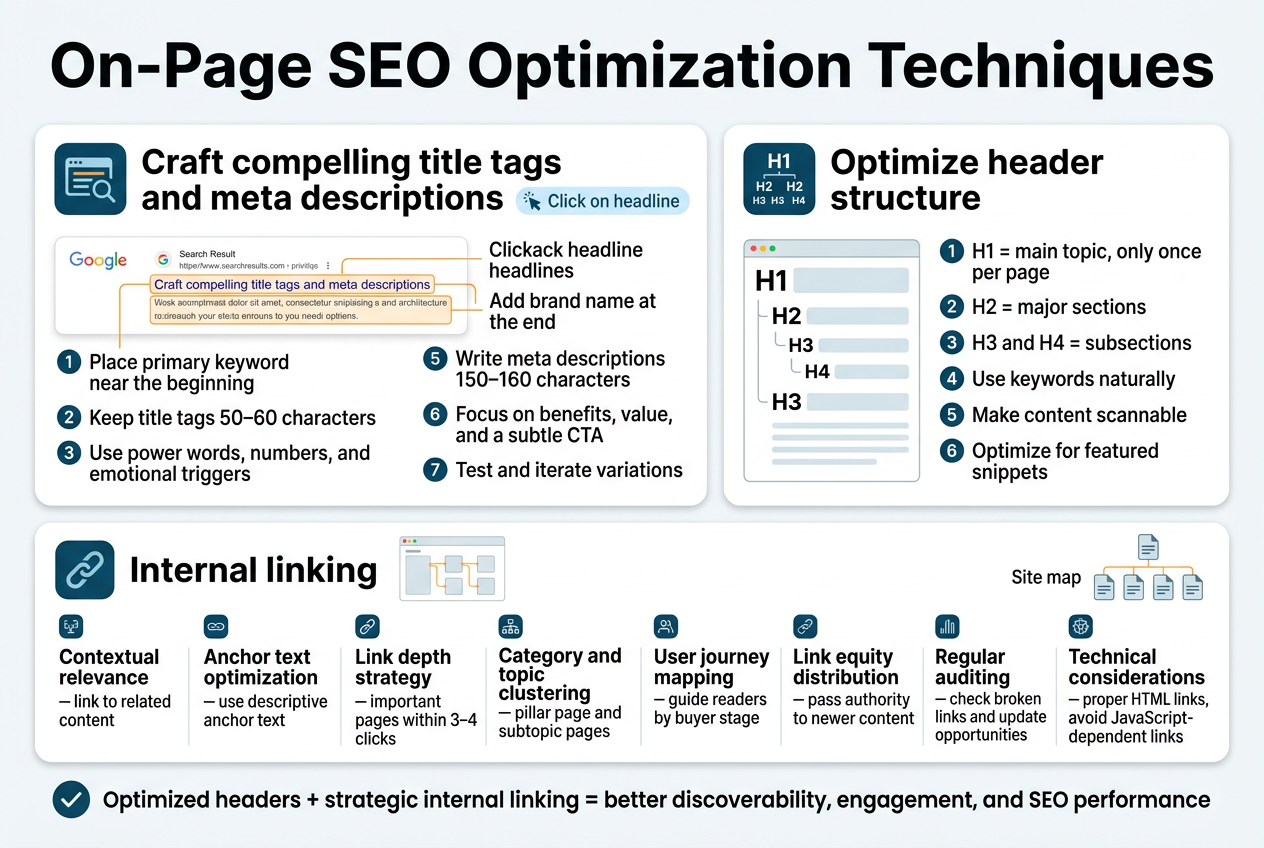
Craft compelling title tags and meta descriptions
Title tags serve as the front door to your content, appearing as clickable headlines in search results. These 50-60 character snippets need to pack a punch while accurately representing your page content. Search engines use title tags as primary ranking signals, making them critical for both SEO performance and user engagement.
Start by placing your primary keyword near the beginning of your title tag. This positioning signals relevance to search engines and catches user attention quickly. Avoid keyword stuffing – instead, create natural, readable titles that humans want to click. Your brand name typically goes at the end, separated by a pipe (|) or dash (-), unless you’re targeting branded searches specifically.
Consider these title tag optimization strategies:
Power words that drive clicks: Words like “ultimate,” “complete,” “proven,” “secret,” “instant,” and “exclusive” can increase click-through rates when used appropriately. However, ensure these words align with your actual content to avoid disappointing users.
Numbers and specificity: Titles with specific numbers often outperform generic ones. “7 Content Marketing Strategies” typically generates more clicks than “Content Marketing Strategies.” The specificity creates clear expectations and suggests actionable, digestible content.
Emotional triggers: Understanding your audience’s pain points allows you to craft titles that resonate emotionally. If your target audience struggles with time management, titles like “Save 10 Hours Weekly With These Content Creation Tools” directly address their concerns.
Local optimization: For location-based businesses, including city or region names in title tags helps capture local search traffic. “Best Coffee Shop in Downtown Seattle” targets users with specific geographic intent.
Meta descriptions function as your content’s sales pitch – a 150-160 character advertisement that convinces searchers to choose your result over competitors. While meta descriptions don’t directly impact rankings, they significantly influence click-through rates, which can indirectly affect your search positions.
Write meta descriptions that expand on your title tag without repeating it word-for-word. Include your primary keyword naturally, but focus on benefits and value propositions. Address what users will gain by clicking through to your content.
Action-oriented language: Use active voice and compelling verbs. Instead of “Information about content optimization can be found here,” try “Discover proven content optimization techniques that boost organic traffic by 200%.”
Unique value proposition: Highlight what makes your content different from competitors. If you’re offering a free template, mention it. If you have exclusive industry insights, call that out. Give users a compelling reason to choose your result.
Call-to-action elements: Subtle CTAs in meta descriptions can improve click-through rates. Phrases like “Learn how,” “Discover why,” “Get started,” or “Find out” encourage user action while feeling natural within the description.
Testing and iteration: Create multiple meta description variations for important pages and test their performance. Google Search Console shows click-through rates for different queries, helping you identify which descriptions resonate best with your audience.
Optimize header structure and internal linking
Header tags (H1, H2, H3, H4) create content hierarchy that benefits both users and search engines. Think of headers as your content’s table of contents – they should guide readers through your material logically while helping search engines understand your content structure.
Your H1 tag represents your page’s main topic and should appear only once per page. This header typically mirrors your title tag but can be longer since it’s not constrained by SERP character limits. Make your H1 descriptive and keyword-rich while maintaining readability.
H2 tags divide your content into major sections, similar to chapter headings in a book. These subheadings should be descriptive enough that someone scanning your page can understand the main points without reading every word. Use H2 tags to target related keywords and long-tail variations of your primary keyword.
H3 and H4 tags create further subdivisions within your H2 sections. This hierarchical structure helps users navigate long-form content and allows search engines to better understand your content’s organization and topic coverage.
Keyword distribution strategy: Naturally incorporate target keywords into your header structure without forced repetition. If your primary keyword is “content marketing,” your headers might target related terms like “content strategy,” “content creation,” “content distribution,” and “content analytics.”
Scannable formatting: Headers should break up large text blocks, making your content more digestible. Most online readers scan before reading, and clear headers help them find relevant sections quickly. This improved user experience can reduce bounce rates and increase time on page.
Featured snippet optimization: Well-structured headers help your content appear in featured snippets. Search engines often pull information from pages with clear H2 or H3 tags that directly answer common questions. Frame some headers as questions your audience asks, then provide comprehensive answers in the following content.
Internal linking connects your content ecosystem, distributing page authority and helping users discover related information. Strategic internal links guide users through your sales funnel while showing search engines the relationships between your pages.
Contextual relevance: Link to related content when it genuinely adds value for readers. If you mention “email marketing” in a blog post about content marketing, link to your comprehensive email marketing guide. This cross-pollination keeps users engaged with your site longer.
Anchor text optimization: Use descriptive anchor text that clearly indicates where the link leads. Instead of “click here” or “read more,” use specific phrases like “complete guide to keyword research” or “social media content calendar template.” This approach helps both users and search engines understand the linked page’s content.
Link depth strategy: Don’t bury important pages deep within your site structure. Ensure high-value content can be reached within 3-4 clicks from your homepage. This accessibility helps search engines discover and index your content more effectively.
Category and topic clustering: Create content clusters around main topics, with pillar pages linking to related subtopic pages. For example, a comprehensive “Content Marketing Guide” pillar page might link to specific posts about blog writing, video content, infographics, and content promotion strategies.
User journey mapping: Consider where users are in their buyer’s journey when adding internal links. Someone reading an introductory article might benefit from links to more advanced guides, while someone on a product comparison page might appreciate links to case studies or pricing information.
Link equity distribution: Internal links pass authority from one page to another. Link from high-authority pages to newer or less-established content you want to boost. This strategy can help new content rank faster and perform better in search results.
Regular auditing: Periodically review your internal linking structure to identify broken links, update outdated references, and spot new linking opportunities. As you publish more content, new internal linking possibilities emerge that can strengthen your overall site authority.
Technical considerations: Ensure internal links use proper HTML formatting and avoid JavaScript-dependent links that search engines might not follow. Use absolute URLs for important internal links to avoid any potential crawling issues.
The combination of optimized headers and strategic internal linking creates a user-friendly, search-engine-friendly content structure that enhances both discoverability and engagement. These elements work together to improve your content’s performance across multiple metrics while providing genuine value to your audience.
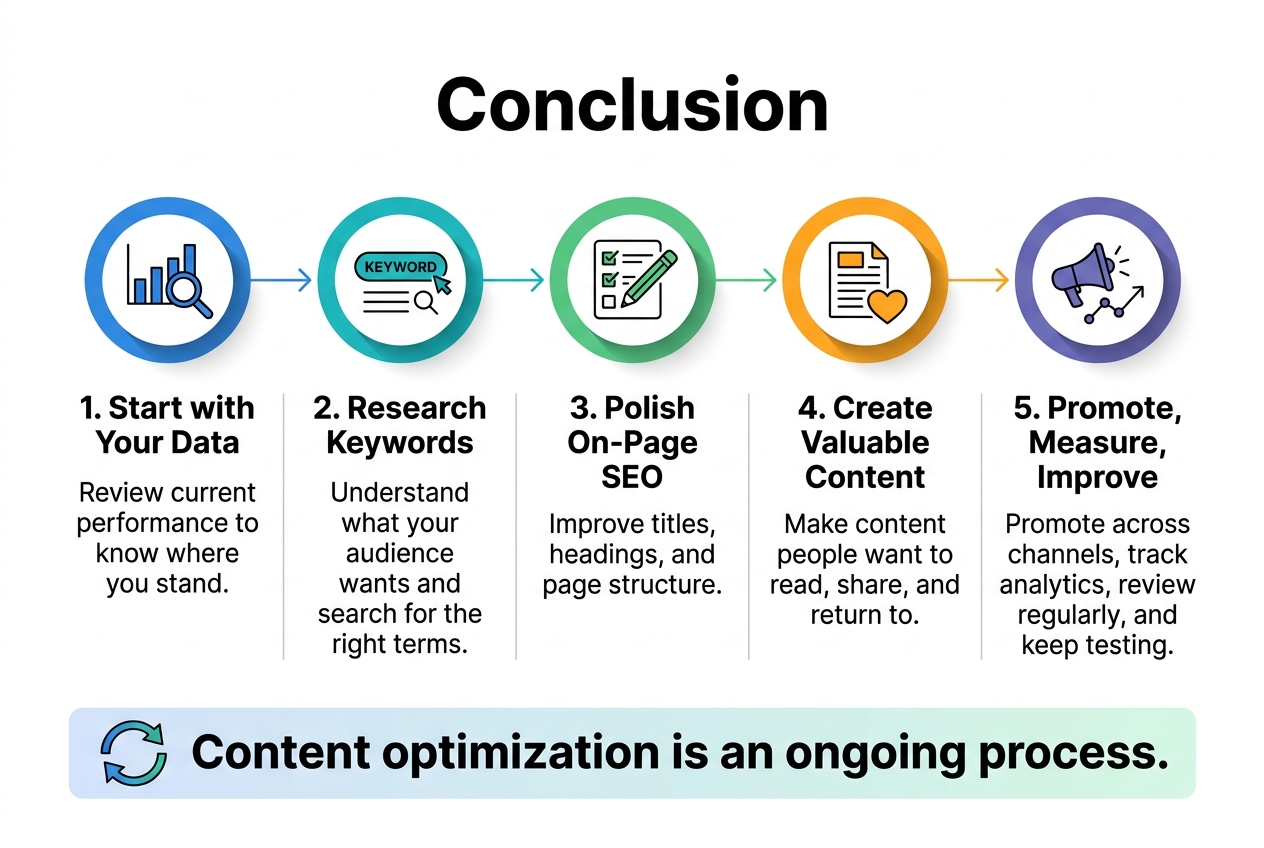
Building a solid content optimization strategy comes down to knowing where you stand, understanding what your audience wants, and making smart improvements along the way. You need to start with your current performance data, dig deep into keyword research, polish up your on-page SEO, and focus on creating genuinely valuable content that people actually want to read and share.
The real magic happens when you combine great content with smart promotion and keep track of what’s working. Don’t just publish and hope for the best – actively promote your content across different channels and watch your analytics like a hawk. Set up a regular review process to see which pieces are hitting the mark and which ones need some love. Remember, content optimization isn’t a one-and-done deal; it’s an ongoing process that gets better with each round of testing and tweaking.

3 Responses