
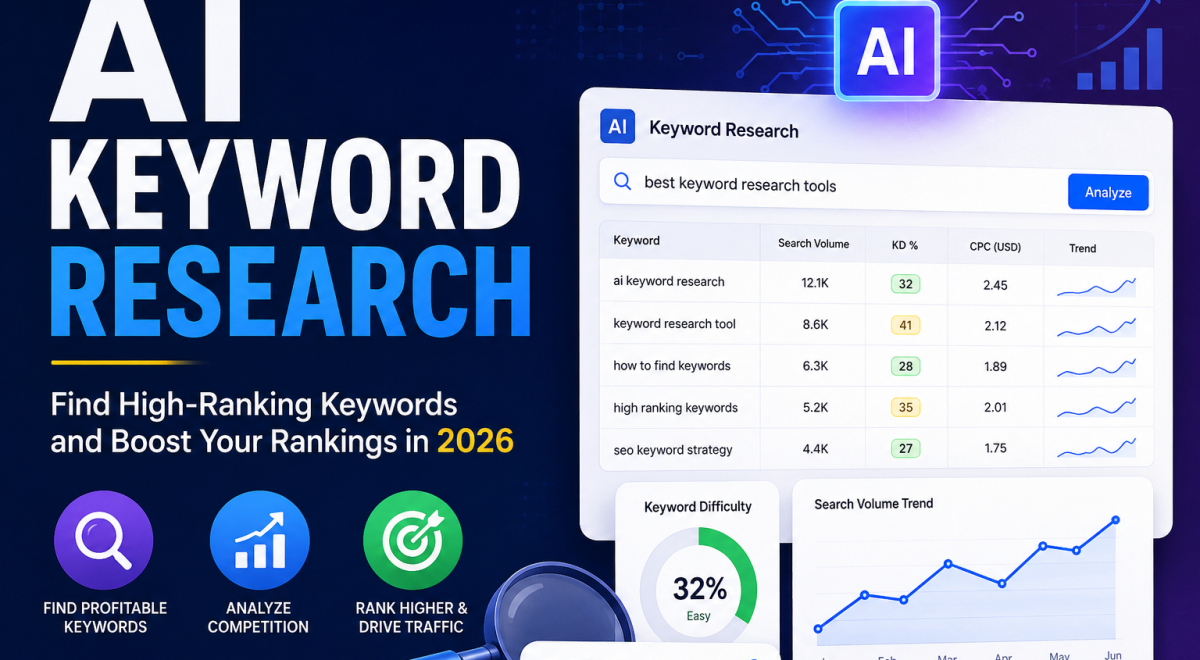
Finding the right keywords has always been one of the most important parts of SEO. Without targeting the words people actually search for, even the best-written content can struggle to attract visitors. Traditional keyword research often involves hours of manual work, including brainstorming ideas, checking search volumes, analyzing competitors, and organizing hundreds of keyword variations. While this process still works, artificial intelligence has transformed it into something much faster, smarter, and more accurate.
AI keyword research combines machine learning, natural language processing, and massive search data to help marketers discover valuable keywords within minutes instead of hours. Rather than simply generating keyword suggestions, AI tools understand relationships between topics, identify user intent, predict search trends, and recommend entire content clusters. This means businesses can build content strategies that match what users are actually looking for instead of relying on guesswork.
Whether you run a blog, an eCommerce store, an affiliate website, or a local business, learning how to use AI for keyword research can significantly improve your SEO strategy. In this guide, you’ll discover how AI keyword research works, why it matters, which tools are worth using, and how to build a winning keyword strategy that drives consistent organic traffic.
What Is AI Keyword Research?
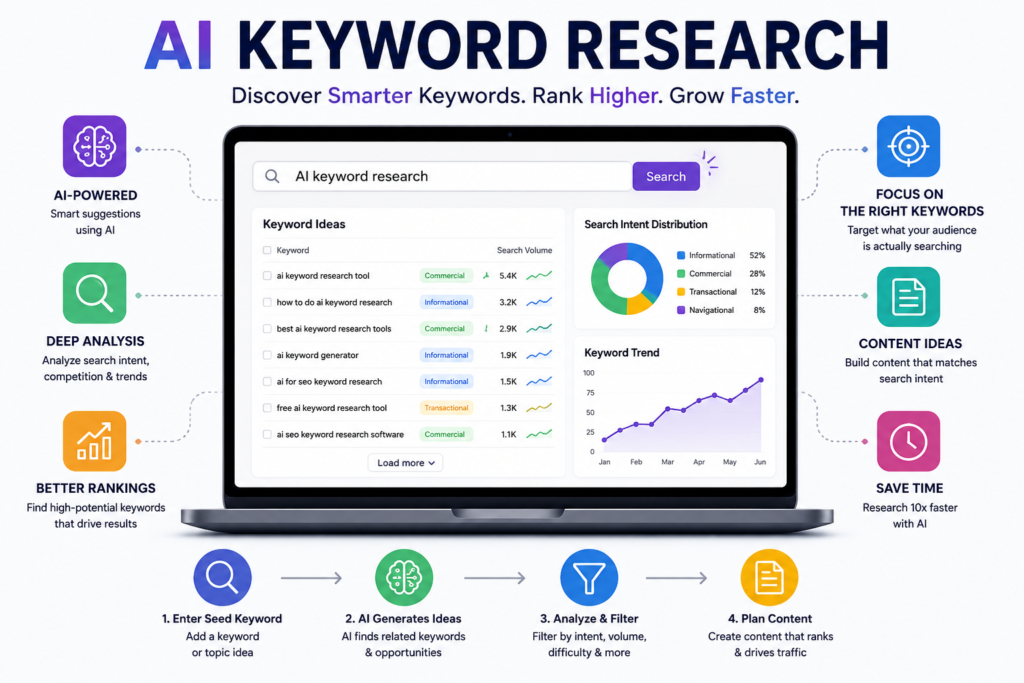
AI keyword research is the process of using artificial intelligence to discover, analyze, and organize keywords that have the greatest potential to generate search engine traffic. Unlike traditional keyword tools that mainly provide lists of related search terms, AI systems analyze language patterns, user behavior, semantic relationships, and search intent to produce more meaningful keyword recommendations.
Imagine trying to solve a giant puzzle with thousands of pieces. Traditional keyword research gives you the individual pieces, but AI helps assemble the puzzle by showing how each keyword connects to broader topics. Instead of treating every keyword independently, AI groups related searches into logical clusters that search engines already recognize as connected. This makes it much easier to create comprehensive content that satisfies readers while improving your chances of ranking higher.
Another major advantage is speed. Tasks that once required hours of manual filtering can now be completed in minutes. AI can instantly identify long-tail keywords, discover emerging search trends, suggest related questions, and even recommend article titles based on user intent. This allows content creators to spend less time researching and more time producing high-quality content that answers real search queries.
How AI Has Changed Traditional Keyword Research
Before AI became widely available, SEO professionals relied heavily on spreadsheets, keyword databases, and manual competitor analysis. They would often export hundreds or even thousands of keywords before filtering them by search volume, keyword difficulty, and commercial value. Although this process produced useful insights, it was slow, repetitive, and often overlooked hidden opportunities.
Artificial intelligence has completely reshaped this workflow. Modern AI-powered tools analyze enormous amounts of search data almost instantly. Instead of simply identifying keywords with high search volume, they understand the meaning behind searches. They recognize synonyms, identify related entities, predict follow-up questions, and determine whether users are looking for information, products, or services.
This shift has become even more important because search engines themselves now rely heavily on artificial intelligence. Google’s ranking systems evaluate topics rather than isolated keywords, rewarding websites that provide comprehensive coverage instead of repeatedly using the same phrase. AI keyword research aligns perfectly with this evolution by encouraging topical authority rather than keyword stuffing.
For content creators, this means building articles around complete subjects instead of chasing individual keywords. As a result, websites can attract traffic from hundreds of related search queries while creating a better experience for readers.
Better Search Intent Analysis
One of the greatest strengths of AI keyword research is its ability to understand search intent. Years ago, SEO was largely about matching the exact words people typed into a search engine. Today, search engines are much smarter. They try to understand the purpose behind every query, and AI-powered keyword research tools are designed to do the same. Instead of simply suggesting related keywords, AI analyzes whether users are looking for information, comparing products, trying to make a purchase, or searching for a specific website. This deeper understanding helps marketers create content that aligns with what users actually expect to find.
Search intent generally falls into four categories: informational, navigational, commercial, and transactional. AI tools automatically classify keywords into these groups, making it much easier to decide what type of content to create. For instance, a keyword like “what is AI keyword research” is informational and works best as an educational blog post. A keyword such as “best AI keyword research tools” has commercial intent, meaning readers are comparing options before making a decision. Meanwhile, searches like “buy Semrush subscription” are transactional because the user is ready to purchase. By recognizing these differences, AI ensures that your content matches user expectations, improving engagement and increasing the likelihood of ranking well.
Understanding intent also reduces wasted effort. Without AI, marketers sometimes create articles targeting keywords that don’t align with their goals, resulting in poor traffic or low conversions. AI minimizes this risk by identifying not only relevant keywords but also the reason people search for them. This allows businesses to create educational content for awareness, comparison guides for potential buyers, and product pages for customers ready to convert. When every page serves a clear purpose, your entire SEO strategy becomes more focused and effective.
Improved Content Planning
Keyword research is only the beginning of a successful SEO strategy. Once you’ve identified valuable keywords, you need a plan for turning them into high-quality content. This is another area where AI delivers enormous value. Instead of generating isolated keyword lists, AI organizes related keywords into logical content clusters. These clusters help you create multiple articles that cover different aspects of the same topic while linking naturally to one another. Search engines view this interconnected structure as a sign of topical authority, increasing your chances of ranking across an entire subject rather than for a single keyword.
AI also simplifies editorial planning by suggesting article titles, subtopics, frequently asked questions, and related searches. For example, if your primary keyword is “AI keyword research,” AI may recommend supporting articles on keyword clustering, AI SEO tools, search intent optimization, long-tail keyword strategies, and AI content optimization. Rather than struggling to think of your next blog post, you’ll have an entire roadmap built around a central topic. This consistency not only benefits SEO but also keeps readers engaged as they explore related content on your website.
For businesses publishing content regularly, AI-powered planning saves considerable time. Marketing teams can build monthly or quarterly content calendars based on keyword opportunities instead of relying on brainstorming sessions. This structured approach ensures that every article contributes to a broader SEO strategy rather than existing in isolation. Over time, publishing interconnected content strengthens your site’s authority, improves internal linking, and creates a better experience for visitors searching for comprehensive information.
How AI Keyword Research Works
Although AI keyword research appears almost magical, the technology behind it is based on advanced data analysis rather than guesswork. AI systems collect enormous amounts of information from search engines, user behavior, content databases, and language models. They then analyze this data to identify patterns that humans would struggle to recognize manually. Instead of simply counting how often keywords appear, AI examines relationships between words, topics, search intent, user engagement, and historical search trends. This deeper analysis allows AI to recommend keywords that are both relevant and strategically valuable.
At the heart of most AI keyword research tools are Natural Language Processing (NLP) and Machine Learning (ML). NLP enables computers to understand human language, including context, synonyms, and sentence structure. Machine learning continuously improves recommendations by analyzing new search data and user interactions. Together, these technologies allow AI to generate keyword suggestions that reflect how real people search rather than relying solely on exact keyword matches. This makes keyword research more aligned with the way modern search engines evaluate content.
AI also considers semantic relationships between topics. Instead of viewing keywords independently, it recognizes that phrases like “AI keyword research,” “AI SEO tools,” “keyword clustering,” and “search intent analysis” all belong to the same broader subject. This encourages content creators to produce comprehensive resources instead of narrowly optimized pages. As search engines increasingly prioritize topical authority, understanding these relationships has become one of the most valuable advantages AI offers SEO professionals.
Natural Language Processing (NLP)
Natural Language Processing, commonly known as NLP, is the technology that enables AI to interpret and understand human language. Rather than focusing only on individual keywords, NLP examines how words relate to each other within sentences and across entire topics. This allows AI tools to recognize synonyms, identify context, understand user questions, and group similar search queries together. For SEO professionals, this means keyword research becomes much more intelligent and reflective of how people naturally communicate.
For example, someone might search for “AI keyword research tools,” while another person searches “software for finding SEO keywords with AI.” Although the wording is different, NLP understands that both users are looking for similar information. Instead of treating these as unrelated keywords, AI groups them together as semantically connected queries. This helps content creators write naturally while still targeting multiple relevant searches within a single article.
NLP also improves content optimization after keyword research is complete. Many AI-powered SEO platforms analyze your article and recommend related terms, entities, and questions that should be included to improve topical relevance. Rather than encouraging keyword stuffing, these recommendations help writers create content that reads naturally while satisfying search engine algorithms. The result is better readability for users and stronger rankings for a broader range of search queries.
Machine Learning Algorithms
Machine learning is one of the driving forces behind modern AI keyword research. Unlike traditional software that follows fixed rules, machine learning systems improve over time by analyzing enormous amounts of data and recognizing patterns. Every day, search engines process billions of searches, and AI tools use this information to understand how users search, what content performs well, and which keywords are becoming more popular. As more data becomes available, machine learning models become increasingly accurate at predicting keyword opportunities and identifying search trends before they become highly competitive.
A major advantage of machine learning is its ability to discover relationships that humans might overlook. For example, a traditional keyword tool may simply suggest variations of a seed keyword, while an AI-powered system can identify related industries, emerging topics, seasonal trends, and complementary search queries. If your primary keyword is AI keyword research, machine learning may recommend related topics such as AI content optimization, topical authority, semantic SEO, voice search optimization, and entity-based SEO. These suggestions help create a comprehensive content strategy that builds authority across an entire niche rather than focusing on a single keyword.
Machine learning also assists with prioritization. Instead of overwhelming users with thousands of keyword ideas, AI evaluates factors such as estimated traffic potential, ranking difficulty, search intent, topical relevance, and competitor strength. This allows marketers to focus on keywords that offer the greatest return on investment. Whether you’re building a brand-new website or expanding an established one, machine learning helps ensure that every piece of content contributes to long-term SEO growth rather than short-term traffic spikes.
Search Intent Detection
One of the most valuable capabilities of AI keyword research is its ability to accurately detect search intent. Search engines no longer reward pages simply because they contain the exact keyword someone typed. Instead, they prioritize content that satisfies the underlying reason behind the search. AI tools analyze search results, user behavior, and language patterns to determine what people truly expect when they enter a query. This insight helps marketers create content that aligns with user expectations while improving their chances of ranking on the first page.
Search intent detection goes beyond identifying whether a keyword is informational or transactional. AI can recognize subtle differences between similar searches. For example, someone searching “best AI keyword research tools” is likely comparing software options, while another person searching “free AI keyword research tool” may be looking for a no-cost solution. Although the keywords appear closely related, the content required to satisfy each search is different. AI helps marketers recognize these distinctions, allowing them to tailor content more effectively.
This capability also improves conversion rates. When visitors find content that perfectly matches their expectations, they are more likely to stay on the page, engage with the material, and take the desired action. Whether that action involves subscribing to a newsletter, purchasing a product, or reading additional articles, matching search intent creates a better user experience while sending positive engagement signals to search engines. Over time, this combination of relevance and user satisfaction contributes to stronger rankings and more consistent organic traffic.
Best AI Keyword Research Tools
Choosing the right AI-powered keyword research tool can make a significant difference in the success of your SEO strategy. While there are dozens of keyword research platforms available today, only a handful combine extensive keyword databases with advanced AI capabilities. The best tools not only generate keyword suggestions but also analyze competition, estimate traffic potential, identify search intent, and recommend complete content clusters. Selecting the right platform depends on your budget, experience level, and SEO goals.
The following table compares some of the most popular AI keyword research tools available today.
| Tool | Best For | Key Features | Ideal User |
|---|---|---|---|
| Semrush | Comprehensive SEO | Keyword Magic Tool, AI content assistance, competitor analysis | Businesses & agencies |
| Ahrefs | Competitor research | Keyword Explorer, backlink analysis, content gap analysis | SEO professionals |
| ChatGPT | Brainstorming | Topic ideas, keyword clustering, content outlines | Bloggers & content creators |
| Google Keyword Planner | PPC & basic SEO | Search volume, keyword forecasts, cost estimates | Beginners & advertisers |
Each platform offers unique strengths. Businesses with larger budgets may prefer all-in-one SEO suites like Semrush or Ahrefs because they provide detailed analytics alongside keyword research. Smaller websites and beginners can combine free resources with AI assistants to generate ideas and organize content efficiently. Regardless of the tool you choose, the most successful strategy is using AI recommendations as guidance while applying human creativity to produce valuable, trustworthy content that serves your audience.
Semrush
Semrush remains one of the most comprehensive SEO platforms available, particularly for marketers seeking advanced AI-assisted keyword research. Its Keyword Magic Tool generates millions of keyword suggestions from a single seed keyword while organizing them into categories based on relevance and search intent. This allows users to quickly identify high-volume keywords, low-competition opportunities, and long-tail variations without manually filtering enormous datasets.
Beyond keyword discovery, Semrush provides valuable competitive insights. Users can analyze which keywords competitors rank for, identify content gaps, and discover new opportunities that may have been overlooked. AI-powered features also assist with content optimization by recommending semantically related keywords and improving topical relevance. This combination of keyword research, competitor analysis, and optimization tools makes Semrush particularly valuable for businesses managing long-term SEO campaigns.
Another advantage is its reporting capabilities. Marketers can monitor keyword rankings, estimate traffic potential, and track performance over time using detailed dashboards. These insights help businesses refine their content strategies based on measurable results rather than assumptions. Although Semrush requires a subscription for its most powerful features, many SEO professionals consider it one of the best investments for building sustainable organic growth.
Ahrefs
Ahrefs is another industry-leading SEO platform widely recognized for its powerful keyword research and backlink analysis capabilities. Its Keyword Explorer tool provides detailed metrics including search volume, keyword difficulty, clicks, traffic potential, and parent topics. Rather than encouraging marketers to chase individual keywords, Ahrefs emphasizes creating content around broader topics that can rank for numerous related searches simultaneously.
One of Ahrefs’ greatest strengths is competitor analysis. Users can enter a competitor’s website and instantly discover which keywords generate the most traffic, which pages perform best, and where content gaps exist. This information helps marketers identify opportunities to create more comprehensive or updated content capable of competing in search results. AI-driven recommendations further simplify this process by highlighting keyword clusters and related search terms.
Ahrefs also excels at monitoring SEO progress after content is published. Users can track keyword rankings, analyze backlink growth, audit technical SEO issues, and evaluate overall website performance within a single platform. This comprehensive approach makes Ahrefs particularly useful for businesses focused on long-term organic growth rather than isolated keyword campaigns. When combined with high-quality content and consistent optimization, its data-driven insights can significantly improve search visibility.
Conclusion
AI keyword research has fundamentally changed how businesses, bloggers, and marketers approach SEO. Instead of relying on manual brainstorming and endless spreadsheets, AI now helps uncover valuable keyword opportunities, understand search intent, organize content into topical clusters, and streamline the entire research process. This allows you to spend less time searching for ideas and more time creating content that genuinely helps your audience.
The most successful SEO strategies in 2026 are no longer built around stuffing a single keyword into an article. Search engines reward websites that demonstrate topical authority, satisfy user intent, and provide comprehensive, trustworthy information. AI makes this easier by identifying semantic relationships, recommending supporting topics, and revealing content gaps that might otherwise go unnoticed. Whether you’re running a niche blog, an affiliate website, an eCommerce store, or a business website, AI can become one of your most valuable SEO assistants.
At the same time, AI should be viewed as a powerful assistant rather than a replacement for human expertise. The best-performing content combines AI-driven insights with original research, personal experience, and clear, engaging writing. By using AI to guide your keyword research while focusing on creating valuable content for real people, you’ll build a stronger online presence, improve your search rankings, and generate sustainable organic traffic for years to come.
Frequently Asked Questions (FAQs)
1. What is AI keyword research?
AI keyword research is the process of using artificial intelligence to discover, analyze, and organize keywords based on search intent, user behavior, semantic relationships, and ranking opportunities. It helps marketers find relevant keywords faster than traditional research methods.
2. Which AI keyword research tool is best?
The best tool depends on your needs. Semrush and Ahrefs are excellent for professional SEO campaigns, Google Keyword Planner is a great free option for beginners, and ChatGPT is useful for brainstorming content ideas, keyword clusters, and article outlines.
3. Can AI replace traditional keyword research?
Not entirely. AI significantly speeds up keyword discovery and analysis, but human judgment is still essential for evaluating relevance, understanding your audience, and creating high-quality content that builds trust and authority.
4. Is AI keyword research good for beginners?
Yes. AI makes keyword research much easier by generating keyword ideas, grouping related topics, identifying search intent, and simplifying content planning. Beginners can develop effective SEO strategies without spending hours on manual research.
5. How do I use AI keyword research to rank higher on Google?
Start with a seed keyword, use AI to generate related keyword ideas, analyze search intent and competition, organize keywords into topical clusters, create comprehensive content, optimize on-page SEO, and regularly update your articles to keep them relevant.
