

Introduction
You know that feeling when your competitors seem to effortlessly outrank you for keywords you’ve been targeting for months? The answer to beating them might be hiding in plain sight – in their own keyword strategies.
Learning how to find competitors keywords gives you a direct roadmap to the search terms that are already working in your industry. This guide is designed for SEO professionals, content marketers, and business owners who want to stop guessing what keywords to target and start making data-driven decisions based on proven competitor success.
We’ll walk you through three core approaches to competitor keyword research: manual methods that cost nothing but time, professional tools that provide comprehensive data and competitor comparisons, and advanced techniques for monitoring new keyword opportunities as they emerge. You’ll also discover how to evaluate which competitor keywords are worth your effort and how to implement them strategically in both your SEO content and PPC campaigns.
Understanding Competitor Keywords and Their Strategic Value
What Are Competitor Keywords and Why They Matter
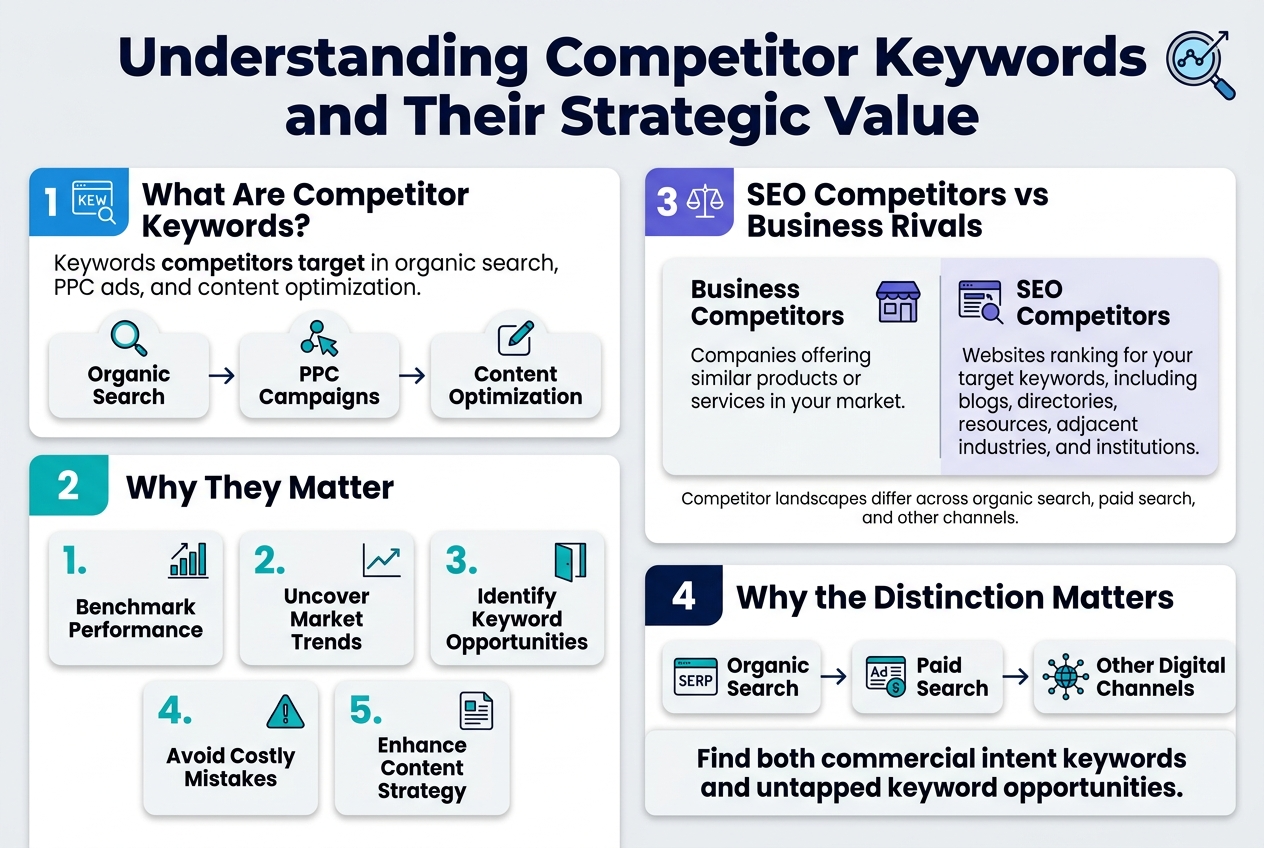
Competitor keyword analysis means identifying and evaluating relevant keywords that your competitors are targeting in their online marketing efforts. This involves thoroughly investigating the keywords that bring traffic to their websites through organic search, the search terms they bid on in PPC campaigns, and the phrases they use to optimize their content.
The goal extends far beyond simply collecting a long list of keywords. It’s about understanding the intent behind these keywords and how they align with your competitors’ overall marketing strategies. This analysis provides insights into specific keywords that are either working well or not well for your competitors, helping you to make informed decisions about your own keyword strategy.
Strategic Benefits of Competitor Keyword Research:
- Benchmarking Performance: By knowing which keywords your organic competitors are targeting, you can gauge your SEO and content strategy against the industry standard, understanding where you stand in comparison to your competition in search engine rankings
- Uncovering Market Trends: The keywords your competitors target often reflect consumer behavior and market trends, providing insights into what your target audience is interested in and searching for
- Identifying Keyword Opportunities: Analysis reveals gaps in your competitors’ strategies, presenting opportunities to target keywords that are relevant but less competitive
- Avoiding Costly Mistakes: Learning from the successes and failures of your competitors’ keyword strategies helps you avoid costly mistakes and make more informed decisions
- Enhancing Content Strategy: This analysis informs your content creation, helping you produce content that is not only SEO-friendly but also more likely to resonate with your audience
SEO Competitors vs Business Rivals: Key Differences
Understanding the distinction between business competitors and SEO competitors is crucial for effective keyword research. As noted by SEO experts, “direct business competitors will not be the same as organic search competitors. The competitor landscape typically varies in different channels, depending on which competitors are investing in SEO, paid search, or other digital marketing channels.”
Business Competitors are companies that offer similar products or services in your market. These are your direct commercial rivals who compete for the same customers and revenue streams.
SEO Competitors, however, are websites that rank for keywords you’re interested in targeting, regardless of whether they’re direct business competitors. This broader category can include:
- Content publishers and blogs
- Industry directories and aggregators
- Information sites and resources
- Companies in adjacent industries
- Educational institutions or government sites
For effective competitor keyword analysis, you need to identify both types of competitors. Your SEO competitors might reveal keyword opportunities that your direct business competitors haven’t discovered, while your business competitors can show you industry-specific terms and commercial intent keywords that drive conversions.
This distinction is particularly important because the competitor landscape varies across different digital marketing channels. A company might dominate organic search results for certain keywords while having minimal presence in paid search, or vice versa. Identifying the different competitors for each channel is essential for collecting comprehensive and informed data about the competitive landscape.
Identifying Your True SEO Competitors
Using SERP Analysis to Find Direct Competitors
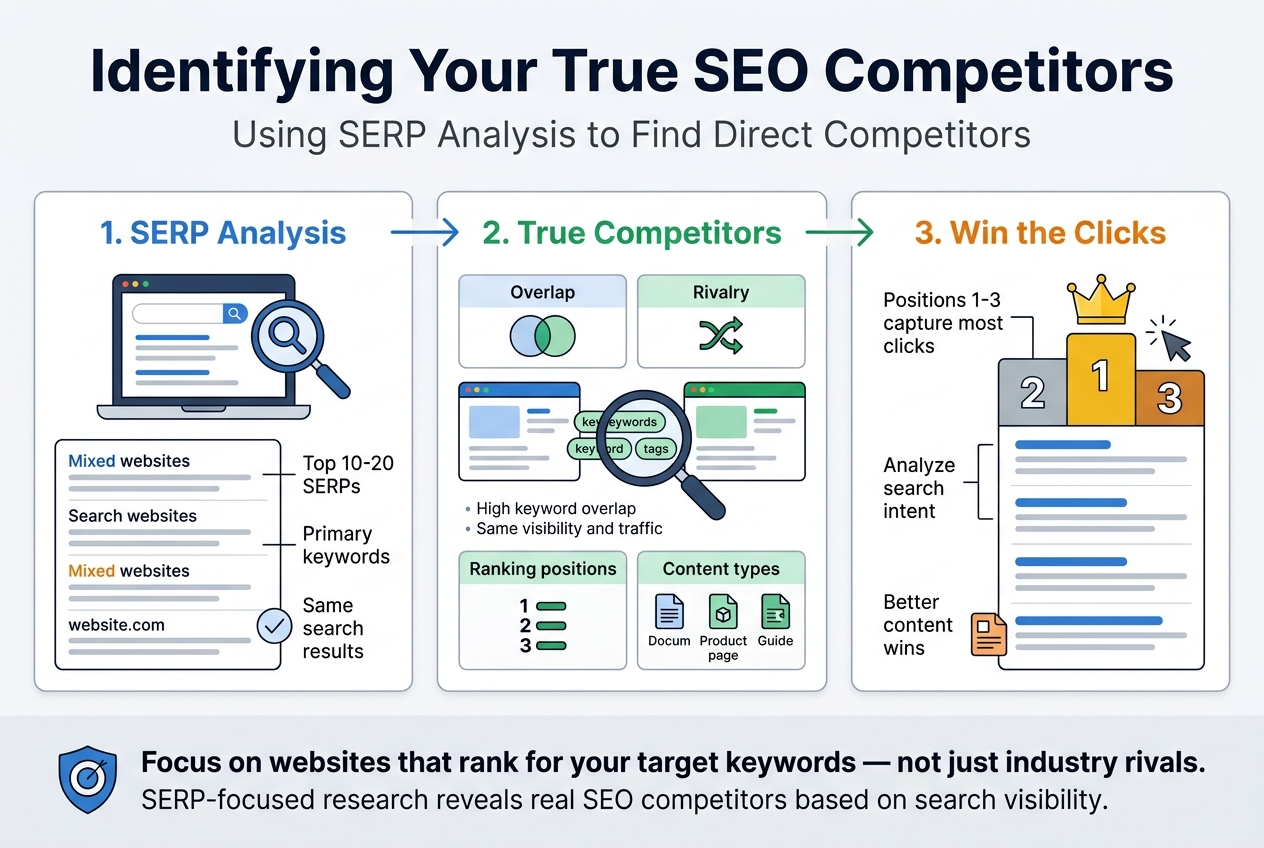
When identifying your true SEO competitors, it’s crucial to look beyond the obvious business competitors and focus on those who actually compete with you in search results. Your real SEO competition consists of websites that appear in the same search engine results pages (SERPs) for your target keywords, regardless of whether they’re in the same industry or not.
The most effective method for identifying direct competitors is through comprehensive SERP analysis. Start by entering your primary keywords into search engines and carefully examine which websites consistently appear in the top 10-20 results. These are your true search competitors because they’re competing for the same visibility and traffic you’re targeting.
To ensure you’re targeting the right competitors, focus on websites that show significant keyword overlap with your site. Tools like Moz Pro’s True Competitor feature can help you explore a thorough list of market competitors based specifically on the SERPs where your site is currently ranking. This approach reveals competitors you might not have considered through traditional market analysis.
Key metrics to evaluate during SERP analysis include:
- Overlap: The percentage of keywords you both rank for
- Rivalry: How often you compete directly in search results
- Ranking positions: Where competitors appear relative to your site
- Content types: What format of content is ranking (blog posts, product pages, guides)
Pay special attention to competitors appearing in positions 1-3 for your most important keywords, as these sites are capturing the majority of clicks and traffic. Additionally, analyze the search intent behind each keyword to understand why certain competitors are ranking higher – they may be better addressing user needs or have more comprehensive content.
This SERP-focused approach ensures your competitive research is grounded in actual search visibility rather than assumptions about market competition.
Using Professional Tools for Comprehensive Competitor Keyword Research
Single Competitor Analysis with Organic Rankings Tools
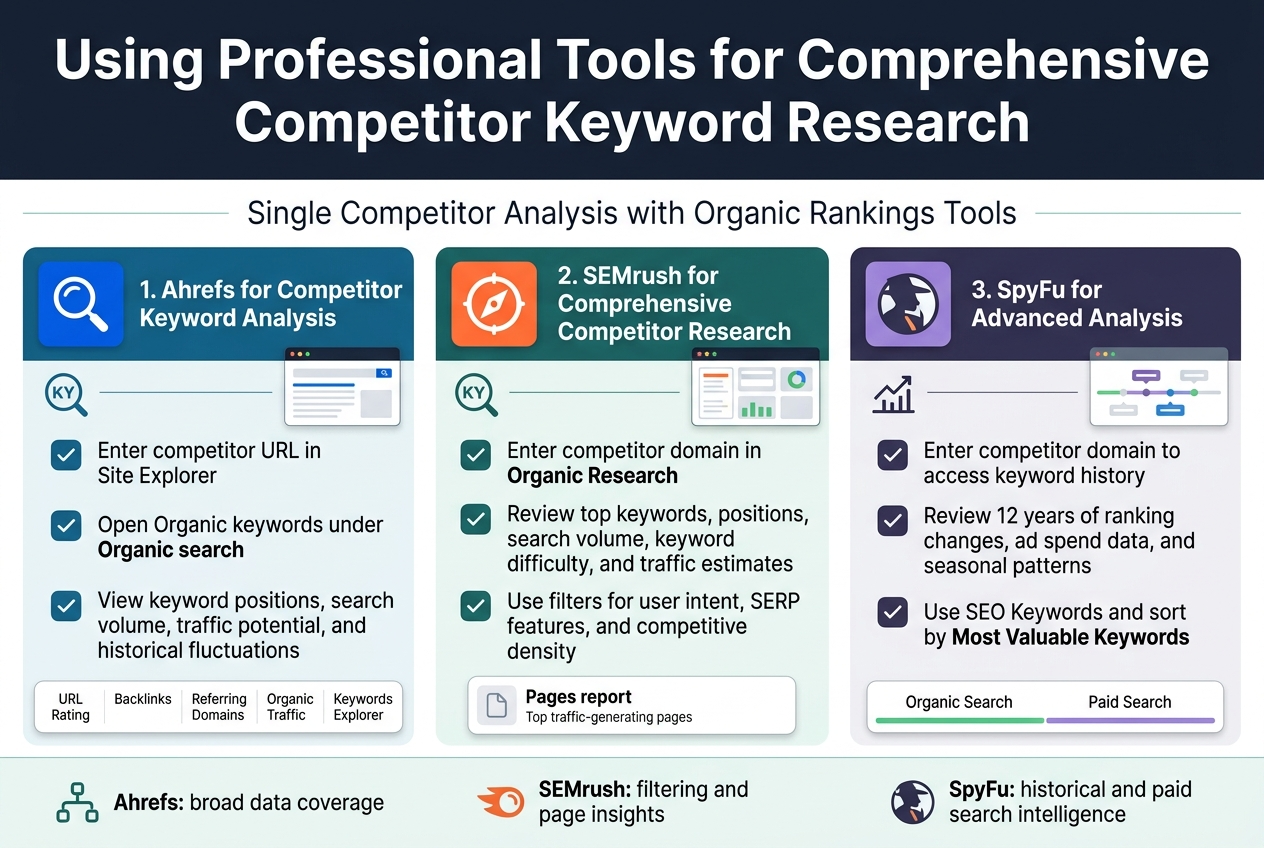
When analyzing a single competitor’s organic keyword strategy, professional SEO tools provide comprehensive insights that manual research simply cannot match. These specialized platforms reveal the complete keyword portfolio of your competitors, including their ranking positions, search volumes, and traffic potential.
Using Ahrefs for Competitor Keyword Analysis
Ahrefs stands out for its extensive data coverage, pulling metrics not only from Google but also from platforms like YouTube, Amazon, Bing, Yahoo, and Baidu. To conduct single competitor analysis, sign into Ahrefs and navigate to Site Explorer. Enter your competitor’s URL and click on “Organic keywords” under the Organic search tab. This reveals their complete keyword profile, showing which terms drive their search traffic, historical keyword performance, and ranking fluctuations over time.
The platform’s Keywords Explorer tool provides valuable insights into search volumes and estimated clicks, enabling you to target keywords that yield meaningful traffic. You can analyze metrics such as URL Rating, backlinks, referring domains, and organic traffic to understand why competitors rank well for specific terms.
Leveraging SEMrush for Comprehensive Competitor Research
SEMrush offers powerful single competitor analysis through its Organic Research feature. Enter your competitor’s domain name and explore their top keywords, which reveals their most valuable organic search terms. The platform displays comprehensive data including keyword positions, search volumes, keyword difficulty levels, and traffic estimates.
The tool’s filtering capabilities allow you to sort keywords by various parameters including user intent, SERP features, and competitive density. SEMrush’s Pages report shows which specific pages generate the most organic traffic, helping you understand their content strategy and identify high-performing topics.
Advanced Analysis with SpyFu
SpyFu specializes in competitive intelligence, providing historical data spanning 12 years for comprehensive competitor analysis. Simply enter a competitor’s domain to access their complete keyword history, including ranking changes, ad spend data, and seasonal performance patterns.
The platform excels at revealing competitor keyword strategies through its SEO Keywords tab, where you can sort results by “Most Valuable Keywords” to identify their highest-impact organic terms. SpyFu’s unique strength lies in combining organic and paid search data, showing how competitors leverage both channels for maximum visibility.
Advanced Competitor Keyword Research Techniques

Identifying New Keywords Competitors Are Ranking For
Now that we have covered the fundamental tools and approaches for competitor keyword research, let’s explore advanced techniques for discovering fresh keyword opportunities your competitors have recently started ranking for. This proactive approach allows you to identify emerging trends and capitalize on new market opportunities before they become oversaturated.
Spotting Trending Keywords Through Competitor Analysis
One of the most effective advanced techniques involves monitoring your competitors for newly acquired rankings. Use comprehensive SEO platforms like Ahrefs or Semrush to track historical ranking data for your competitors’ websites. Focus on keywords where competitors have recently entered the top 10 search results or have shown significant ranking improvements over the past 3-6 months.
Pay particular attention to keywords that are starting to gain traction but haven’t yet reached peak competition levels. These emerging opportunities often represent topics or search queries that are becoming more popular but haven’t been fully exploited by the broader market yet.
Analyzing Rising Content Performance
When you identify competitors who have recently started ranking for new keywords, reverse engineer their content strategy. Examine what type of content they’re creating – whether it’s blog posts, product pages, or comprehensive guides. Look at their on-page SEO implementation, content depth, and the additional keywords they’re targeting within the same piece of content.
This analysis reveals not just the keywords themselves, but the content approach that’s proving successful. Understanding what’s driving their quick ranking success can guide your own content creation efforts and help you outrank them while the keyword opportunity is still fresh.
Leveraging Competitor Backlink Analysis for Keyword Discovery
Mine your competitors’ backlink profiles to uncover valuable keyword opportunities they might not be directly targeting. Use backlink analysis tools to examine the anchor text of links pointing to your competitors’ websites. Often, this anchor text contains keywords that reveal how others in your industry perceive and categorize your competitors’ content.
Focus on the context surrounding these backlinks by reading the paragraphs around the link placement. This context can reveal specific user needs or content angles that naturally earn backlinks, providing you with keyword ideas that have proven link-earning potential.
Evaluating and Selecting the Best Competitor Keywords
Understanding Key Metrics: Search Intent, Volume, and Difficulty
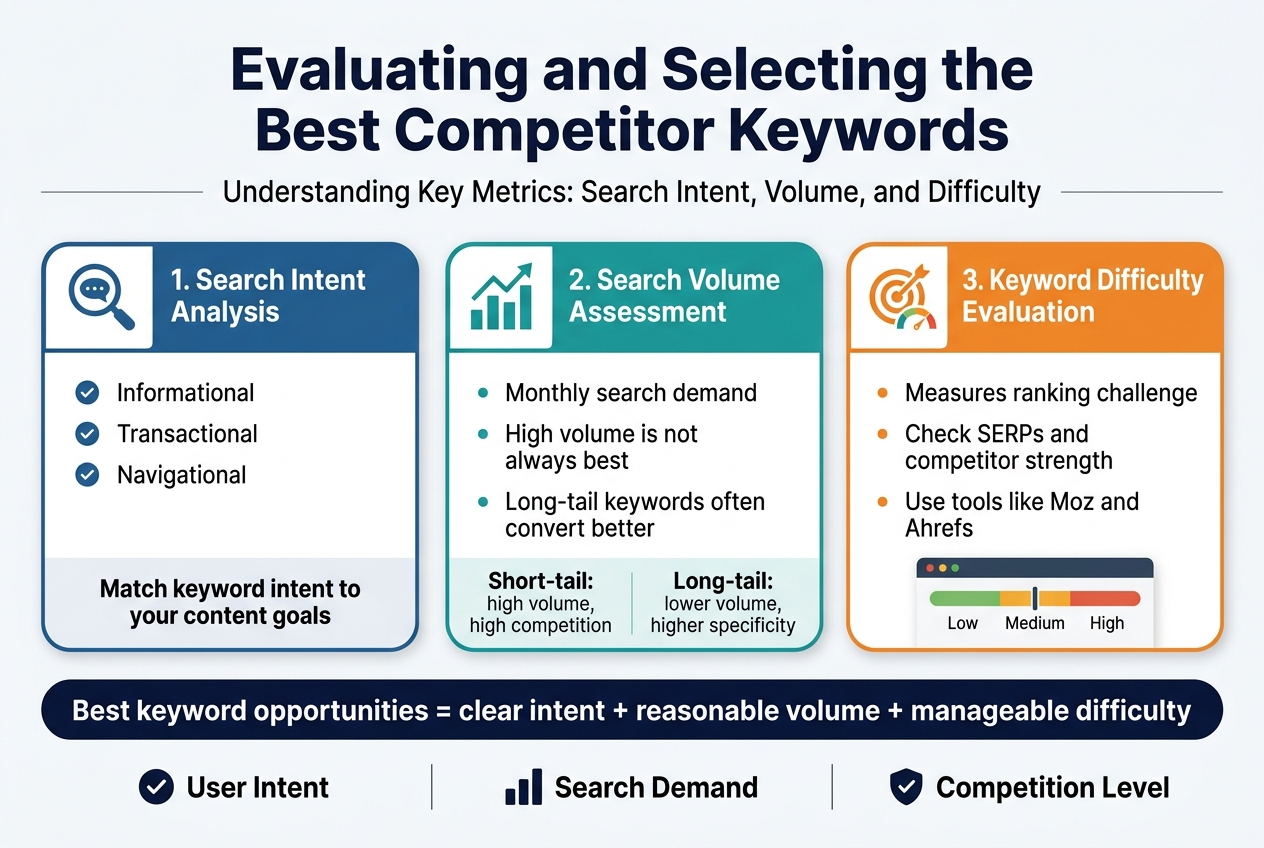
Now that we have covered how to identify and gather competitor keywords, the next crucial step involves evaluating these keywords using three fundamental metrics that determine their strategic value for your SEO efforts.
Search Intent Analysis
Search intent represents the underlying purpose behind a user’s search query and is perhaps the most critical factor in keyword evaluation. When analyzing competitor keywords, you must understand whether users are seeking information, looking to make a purchase, or trying to navigate to a specific website. Keywords with high search volumes mean nothing if they don’t align with your content’s ability to satisfy user intent.
Previously, search engines focused primarily on keyword matching, but today’s algorithms prioritize user experience and content relevance. This means that understanding search intent becomes essential for determining which competitor keywords deserve your attention. For instance, if your competitor ranks well for informational queries like “how to use X,” but your business model focuses on direct sales, these keywords may not provide the competitive advantage you’re seeking.
Search Volume Assessment
Search volume indicates how many people search for a specific keyword within a given timeframe, typically measured monthly. While high-volume keywords might seem attractive, they’re not always the best choice for your strategy. The reference content emphasizes that keywords with moderate search volume and low competition could present golden opportunities, especially when compared to high-volume terms with intense competition.
When evaluating competitor keywords, consider both short-tail and long-tail variations. Short-tail keywords like “shoes” typically have high search volumes but are highly competitive and may not drive targeted traffic. Conversely, long-tail keywords such as “women’s red running shoes” tend to have lower search volumes but often boast higher conversion rates due to their specific nature and clearer search intent.
Keyword Difficulty Evaluation
Keyword difficulty measures how challenging it would be to rank for a particular keyword, considering the current competitive landscape. This metric is crucial when prioritizing which competitor keywords to target in your SEO strategy.
With this in mind, next, we’ll see how search volume intersects with competition levels. A keyword with high search volume but intense competition might be challenging to rank for, particularly if the current top-ranking pages are from authoritative, well-established websites. Tools like Moz’s Keyword Difficulty Score or Ahrefs’ Keyword Difficulty provide numerical values to gauge ranking challenges.
When analyzing competitor keyword difficulty, examine the Search Engine Results Pages (SERPs) for each target keyword. If competitors dominating these results have high domain authority, extensive backlink profiles, and comprehensive content, you’ll need to assess whether your resources can compete effectively in that space.
Strategic Integration of Metrics
The most effective approach combines all three metrics rather than focusing on any single factor. Keywords that demonstrate clear search intent alignment with your content goals, reasonable search volume for your market size, and manageable difficulty levels based on your domain authority represent the sweet spot for competitive keyword targeting.
Understanding these metrics enables you to make data-driven decisions about which competitor keywords deserve immediate attention and which might be better suited for long-term strategic development.
Strategic Implementation of Competitor Keywords
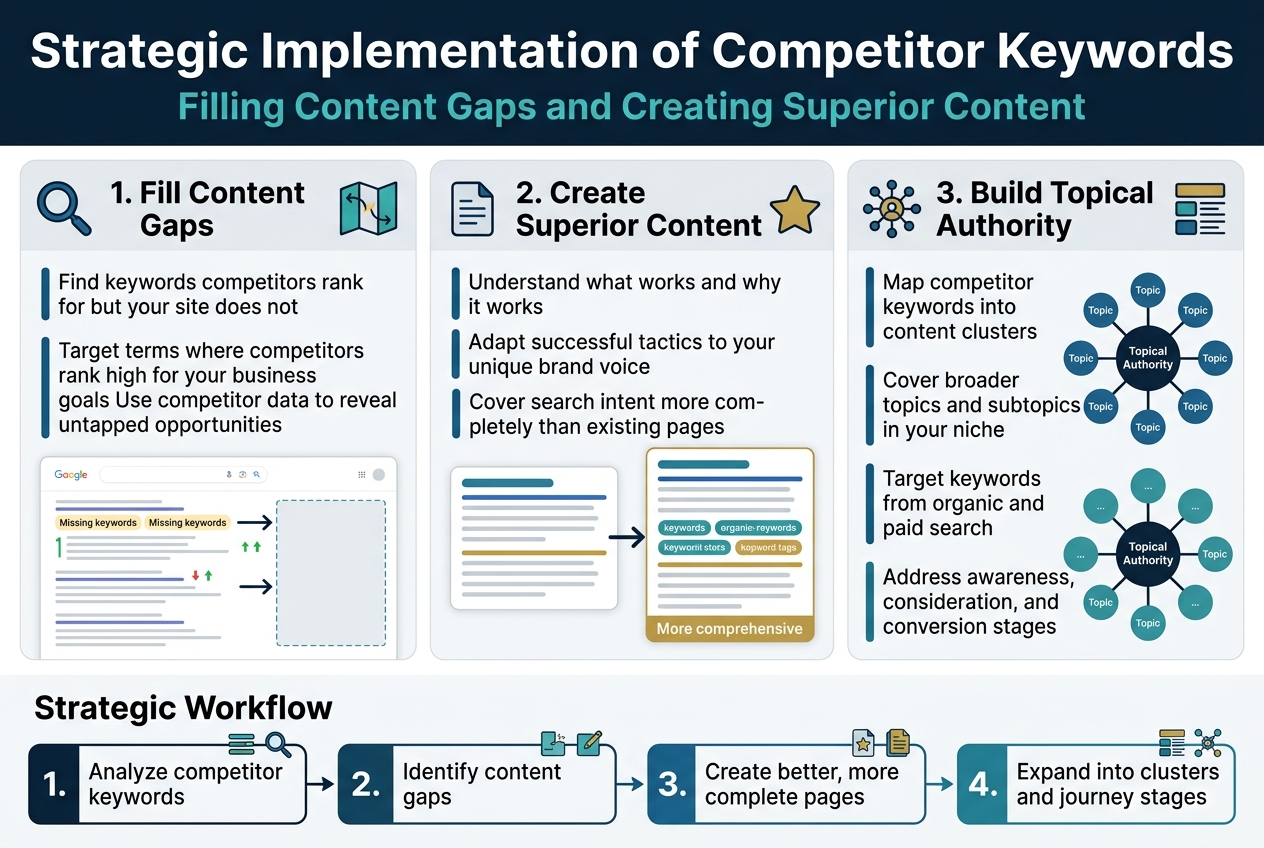
Filling Content Gaps and Creating Superior Content
Now that we have gathered comprehensive data about competitor keywords, the next crucial step involves strategically implementing these insights to create content that not only fills existing gaps but surpasses what competitors are currently offering. The process begins with identifying keywords that competitors rank for but your site doesn’t, which reveals untapped opportunities in your content strategy.
When analyzing competitor keyword data, focus particularly on terms where competitors consistently rank high in search results for specific keywords that align with your business objectives. This indicates that search engines view these competitors as trustworthy and authoritative sources for those particular terms. By intelligently incorporating these successful keywords into your strategy, you can demonstrate that your website is equally relevant and reliable.
The key to effective implementation lies in understanding what works and why it works, rather than simply copying competitor strategies. Use the insights from competitor keyword research to inform your own content creation approach, adapting successful tactics to your unique context and brand voice. This approach helps you gain a competitive edge while maintaining authenticity.
Pay special attention to keywords used in competitors’ content by conducting thorough content audits. Tools like SE Ranking’s SERP Analyzer can reveal the specific queries that top-ranking competitors use in their pages, providing detailed insights into their content optimization strategies. By analyzing these terms in both common and separate list formats, you can identify patterns and opportunities for creating more targeted, effective content.
When creating superior content, consider the search intent behind competitor keywords and ensure your content not only targets these terms but provides more comprehensive, valuable information than existing pages. This strategy helps establish your content as the preferred resource for users and search engines alike.
Building Topical Authority Through Comprehensive Coverage
Previously, we’ve explored how to identify and analyze competitor keywords, but building long-term SEO success requires establishing topical authority through comprehensive content coverage. Competitor keyword research serves as the foundation for understanding the full scope of topics and subtopics within your industry that search engines consider authoritative.
With this comprehensive keyword data in mind, next, we’ll examine how to strategically organize and implement these insights to build robust topical authority. The process involves mapping competitor keywords to create content clusters that demonstrate your expertise across interconnected topics within your niche.
Analyze the terms that competitors use in their content to identify gaps in topical coverage. This analysis should extend beyond individual keywords to encompass the broader themes and concepts that competitors address. By understanding the full spectrum of topics your competitors cover, you can develop a more comprehensive content strategy that positions your site as an authoritative source.
Consider keywords that competitors target in both their organic campaigns and paid search efforts, as this dual approach often indicates high-value topics worth investing in. The data from competitor analysis can inspire you to produce more relevant, high-quality content that satisfies user search intent while enhancing your overall search visibility and user engagement.
Focus on creating content that addresses multiple related keywords within a single topic area, demonstrating depth of knowledge and expertise. This approach signals to search engines that your site provides comprehensive coverage of important industry topics, contributing to improved topical authority and better rankings across related search terms.
Monitor competitor keywords that target different stages of the customer journey, from awareness to conversion, ensuring your content strategy addresses the complete spectrum of user needs and search intents within your industry vertical.
Leveraging Competitor Keywords for PPC Campaigns
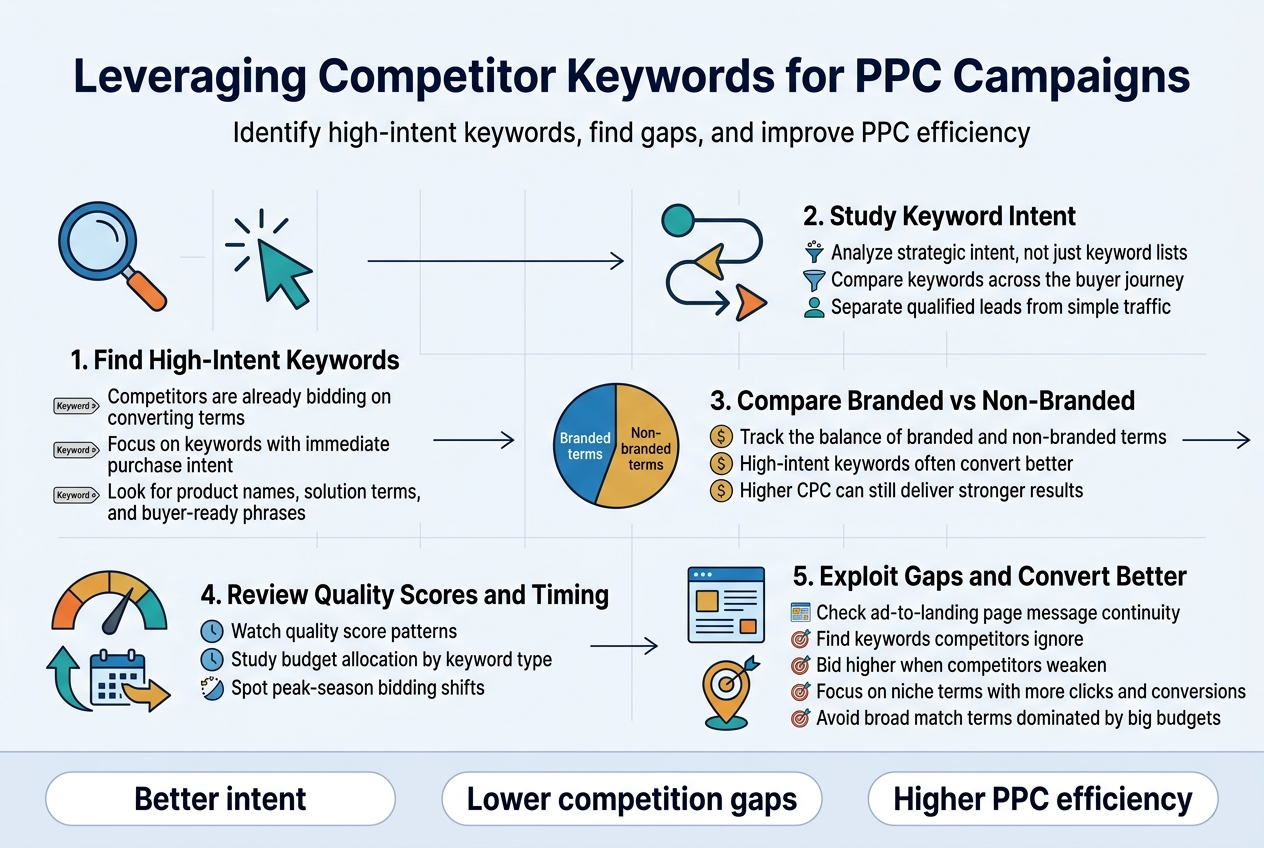
Leveraging Competitor Keywords for PPC Campaigns
Identifying High-Intent Keywords for Paid Search
Now that we have covered how to discover and analyze competitor keywords, the next crucial step is leveraging these insights to build effective PPC campaigns. The key to successful paid search lies in identifying high-intent keywords that your competitors are already bidding on and converting well.
When conducting competitive PPC analysis, focus on understanding the strategic intent behind competitor keyword choices rather than simply copying their approach. Examine not just which keywords they’re bidding on, but how their strategy shifts across different stages of the buyer journey. This deeper analysis reveals which terms are driving qualified leads versus those that merely generate clicks.
Pay particular attention to the distribution between branded and non-branded terms in competitor campaigns. High-intent keywords often include specific product names, solution-focused terms, and buyer-ready phrases that indicate immediate purchase intent. These keywords typically have higher conversion rates despite potentially higher costs per click.
The most valuable insights come from understanding competitor keyword quality scores and how they balance budget across different keyword types. Watch for patterns in their bidding strategy during peak seasons and identify gaps in their keyword coverage that might represent opportunities for your campaigns. Sometimes the most valuable insights come from what competitors aren’t doing – these gaps often represent prime opportunities for your campaigns to capture valuable traffic with less competition and lower costs.
When analyzing competitor landing pages, examine how they maintain message continuity from their ads to their landing pages and guide visitors toward conversion. This analysis helps identify which keywords are truly driving business value versus those that simply generate traffic. Focus on keywords where competitors consistently maintain strong ad positions with compelling landing page experiences, as these indicate proven performance.
To maximize your PPC budget efficiency, consider bidding higher at specific times when you’ve identified competitor weaknesses or reduced activity. Focus efforts on niche search terms that deliver more clicks and conversions rather than competing directly on high-volume but low-converting broad match keywords where established players dominate through larger budgets.
Monitoring and Optimizing Your Competitor Keyword Strategy
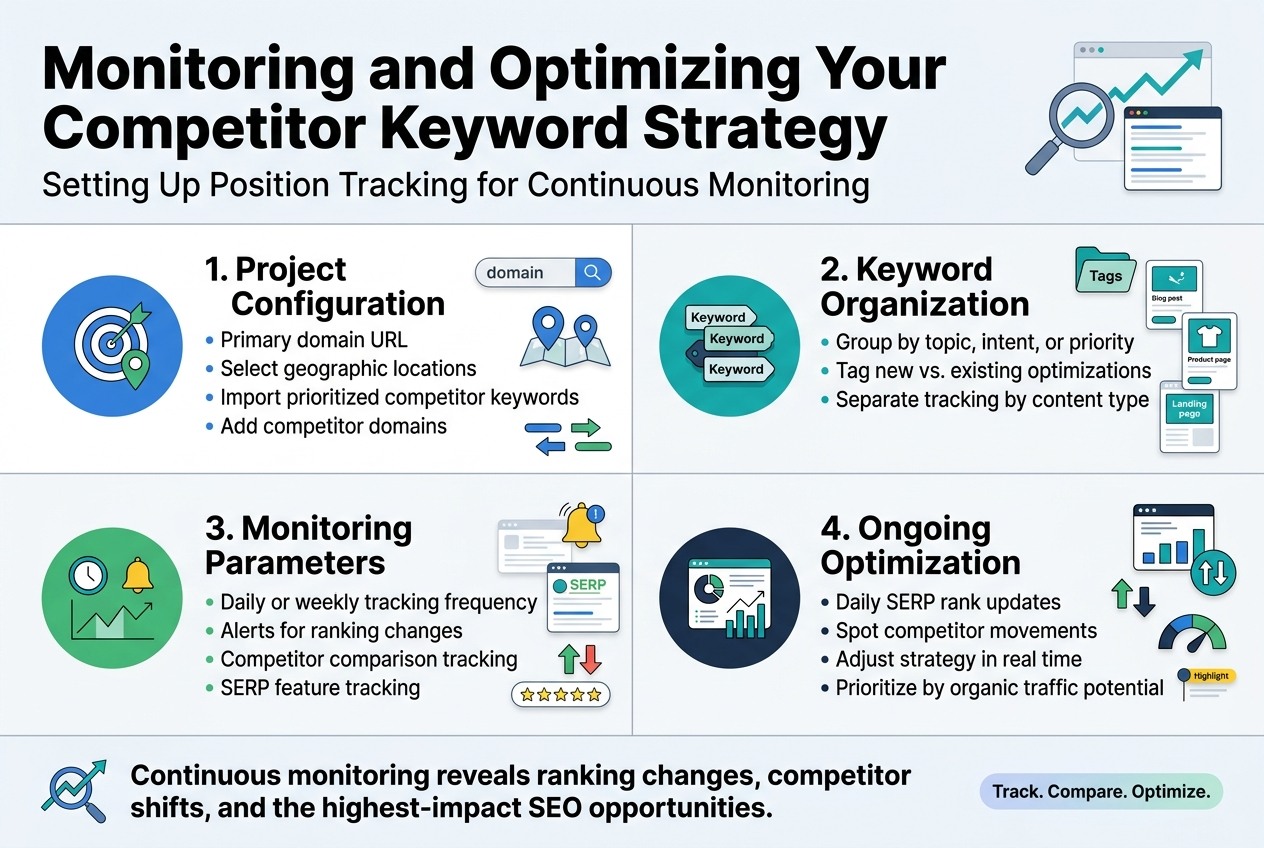
Setting Up Position Tracking for Continuous Monitoring
Now that we have covered how to implement competitor keywords strategically, the next critical step is establishing a robust monitoring system to track performance and optimize your strategy continuously. Setting up position tracking ensures you can monitor both your progress and your competitors’ movements in search rankings.
To begin position tracking for competitor keyword monitoring, you’ll need to utilize professional rank tracking tools like SERPWatcher or SE Ranking’s position tracking features. Start by creating a new tracking project for your domain within your chosen rank-tracking tool, then import all the keywords you discovered during your competitor keyword analysis phase.
The setup process involves several key components:
Project Configuration
- Enter your primary domain URL as the main tracking target
- Select the specific geographic locations where you want to monitor rankings
- Import the competitor keywords you’ve identified and prioritized
- Add your main competitors’ domains for comparative tracking
Keyword Organization
- Group keywords by topic, search intent, or priority level
- Tag keywords based on whether they’re newly targeted or existing optimizations
- Set up separate tracking for different content types (blog posts, product pages, landing pages)
Monitoring Parameters
- Configure daily or weekly tracking frequency based on your needs
- Set up alerts for significant ranking changes (both positive and negative)
- Enable competitor comparison features to track relative performance
- Include SERP feature tracking to monitor rich snippets and other search enhancements
Once configured, your tracking system will provide daily updates about ranking changes in Google SERPs, allowing you to quickly identify when competitors gain or lose positions for target keywords. This continuous monitoring enables you to spot trends, react to competitor movements, and adjust your strategy based on real-time performance data.
The tracking system should also monitor estimated organic traffic potential, helping you prioritize which ranking improvements will have the greatest impact on your overall SEO performance.
Conclusion
Finding and analyzing competitor keywords is one of the most powerful strategies for improving your SEO and PPC performance. By understanding what terms drive traffic to your competitors, you can identify content gaps, discover new opportunities, and make data-driven decisions about your keyword strategy. Whether you’re using manual methods or professional tools like Semrush’s Keyword Gap and Organic Rankings, the key is to focus on keywords that match your business goals and have realistic competition levels for your site’s authority.
The real value comes not from copying your competitors, but from using their insights to inform your unique approach. Start by identifying your true SEO competitors, then systematically analyze their keyword strategies to find missing opportunities and high-intent terms. Remember to track your progress over time and refine your approach based on performance data. With consistent competitor keyword research and strategic implementation, you’ll be well-positioned to compete effectively in search results and capture more qualified traffic for your business.
