



What Is SEO Content (And How Do You Actually Write It)?
If you’ve been publishing blog posts for a while but still can’t figure out why Google keeps ignoring them, you’re in the right place.
This guide is for bloggers, content creators, and small business owners who want to write SEO friendly content that actually shows up in search results — without sounding robotic or stuffing keywords into every sentence.
Here’s what we’ll walk through together:
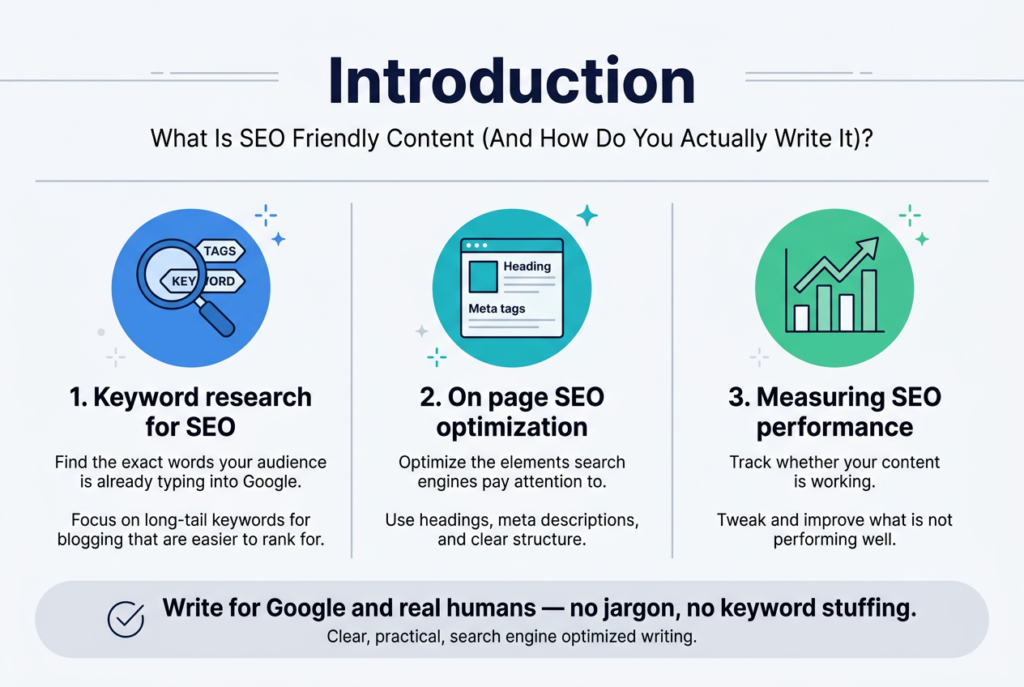
- Keyword research for SEO — how to find the exact words your audience is already typing into Google, including long-tail keywords for blogging that are easier to rank for
- On page SEO optimization — the specific elements on your page that search engines pay close attention to, from headings to meta descriptions
- Measuring SEO performance — how to tell if your content is working and what to tweak when it’s not
No jargon, no guesswork. Just a clear, practical breakdown of what goes into search engine optimized writing that both Google and real humans enjoy reading.
Let’s get into it.
Understanding SEO Friendly Content

What Makes Content SEO Friendly
SEO friendly content is writing that both search engines and real people actually want to engage with. That might sound simple, but getting that balance right is where most content creators stumble. Search engines like Google have become incredibly good at understanding what users genuinely need — so gaming the system with keyword stuffing or thin content just doesn’t work anymore.
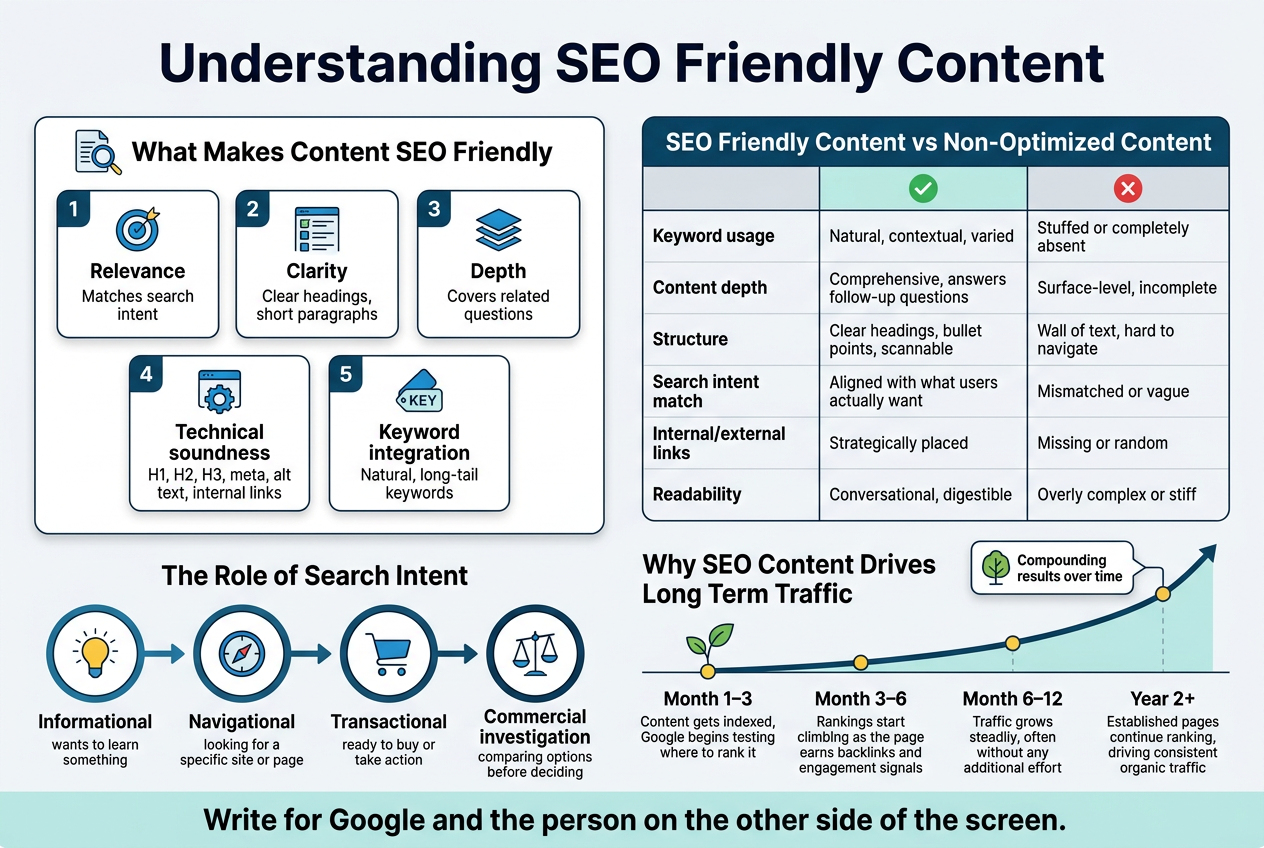
At its core, search engine optimized writing hits several key marks:
- Relevance — The content directly answers what the searcher is looking for, matching their intent rather than just matching words on a page.
- Clarity — Ideas are organized logically, with clear headings, short paragraphs, and language that doesn’t make readers work too hard.
- Depth — Shallow content rarely ranks. Pages that go deep on a topic, cover related questions, and provide real value consistently outperform thin competitors.
- Technical soundness — Proper use of headings (H1, H2, H3), meta descriptions, image alt text, and internal linking all signal to search engines that your content is structured and credible.
- Keyword integration — Relevant keywords are woven in naturally, not forced. Long-tail keywords for blogging are especially powerful here because they match specific queries people are actually typing.
Here’s a quick breakdown of what separates SEO friendly content from content that just sits there collecting digital dust:
| Factor | SEO Friendly Content | Non-Optimized Content |
|---|---|---|
| Keyword usage | Natural, contextual, varied | Stuffed or completely absent |
| Content depth | Comprehensive, answers follow-up questions | Surface-level, incomplete |
| Structure | Clear headings, bullet points, scannable | Wall of text, hard to navigate |
| Search intent match | Aligned with what users actually want | Mismatched or vague |
| Internal/external links | Strategically placed | Missing or random |
| Readability | Conversational, digestible | Overly complex or stiff |
When you nail these elements, you’re not just writing for Google — you’re writing for the person on the other side of the screen who needs a real answer.
The Role of Search Intent
One thing that separates good SEO content from great SEO content is a deep understanding of search intent. Every query falls into one of a few categories:
- Informational — The person wants to learn something (“how to write SEO content”)
- Navigational — They’re looking for a specific site or page
- Transactional — They’re ready to buy or take action
- Commercial investigation — They’re comparing options before making a decision
Matching your content to the right intent is non-negotiable. You can have the most beautifully written article in the world, but if it’s answering the wrong question for the audience landing on it, it won’t rank — and it definitely won’t convert.
Why SEO Content Drives Long Term Traffic
Paid ads stop the moment you stop paying. Social media posts get buried in feeds within hours. But a well-crafted piece of content that ranks on Google can keep pulling in traffic for months or even years without any additional spend. That’s the real power behind a solid SEO content strategy.
Think of SEO content like planting seeds. The effort you put in today — the research, the writing, the optimization — keeps paying off long after you’ve moved on to your next piece. A blog post that earns a spot on page one for a competitive keyword becomes a long-term traffic asset for your entire site.
Compounding Returns Over Time
Unlike almost any other marketing channel, SEO delivers compounding results. Here’s what that typically looks like:
- Month 1–3: Content gets indexed, Google begins testing where to rank it
- Month 3–6: Rankings start climbing as the page earns backlinks and engagement signals
- Month 6–12: Traffic grows steadily, often without any additional effort on your part
- Year 2+: Established pages continue ranking, driving consistent organic traffic
The longer your content sits on a trusted, authoritative domain with strong backlinks, the harder it becomes for competitors to displace it.
Building Content Authority That Stacks
Every piece of SEO friendly content you publish adds to the overall authority of your site. Google evaluates domains holistically — meaning a well-developed content library signals expertise and trustworthiness in your niche. This concept ties directly into improving content authority, which is the process of consistently publishing high-quality, well-linked content that earns trust over time.
Here’s why this matters practically:
- Topical authority — Covering a subject comprehensively across multiple pieces tells Google your site is a genuine resource, not a one-hit wonder.
- Internal linking opportunities — More content means more chances to connect related pages, which distributes ranking power across your site.
- Higher click-through rates — Established pages with strong meta titles and descriptions tend to earn more clicks, sending positive engagement signals back to Google.
- Evergreen traffic — Content built around stable, long-term search queries (especially informational topics) stays relevant without constant updates.
The brands and creators winning at SEO right now aren’t the ones who publish constantly without strategy. They’re the ones treating every piece of content as a long-term investment — researching carefully, writing thoroughly, and optimizing strategically. That’s the difference between content that spikes and fades versus content that quietly builds your audience for years.
Mastering Keyword Research for Better Rankings
Find High Value Keywords Your Audience Searches For
Keyword research is the backbone of any solid SEO content strategy. Without it, you’re essentially writing in the dark — producing content that might never reach the people who actually need it. The goal here isn’t just to find words with high search volume. It’s about finding the right words — the ones your target audience types into Google when they have a problem you can solve.
Start With Search Intent, Not Just Search Volume
Before you dive into any keyword tool, get clear on why someone would search for a particular phrase. Search intent falls into four main buckets:
- Informational – The user wants to learn something (e.g., “how to write SEO content”)
- Navigational – They’re looking for a specific website or brand
- Commercial – They’re comparing options before buying (e.g., “best SEO tools 2024”)
- Transactional – They’re ready to take action (e.g., “buy SEO content writing service”)
Matching your content to the right intent is what separates content that ranks on Google from content that just sits there collecting dust.
Use the Right Tools to Uncover Keyword Opportunities
You don’t need to guess what your audience is searching for. Several powerful tools can show you exactly that:
| Tool | Best For | Pricing |
|---|---|---|
| Google Keyword Planner | Basic volume data, beginner-friendly | Free |
| Ahrefs | In-depth keyword analysis, competitor research | Paid |
| Semrush | Full SEO suite, keyword gap analysis | Paid |
| Ubersuggest | Budget-friendly keyword suggestions | Free/Paid |
| AnswerThePublic | Question-based keyword discovery | Free/Paid |
Start with a broad “seed keyword” — something like “SEO friendly content” — and let these tools branch it out into hundreds of related phrases. Look for keywords that strike a balance between decent search volume and manageable competition.
Go Deep With Long-Tail Keywords
One of the biggest mistakes new bloggers and content creators make is going straight for the big, competitive keywords. Trying to rank for “SEO” as a brand-new site is like showing up to the Olympics without training. Long-tail keywords for blogging, on the other hand, are your best friends early on.
Long-tail keywords are longer, more specific phrases — usually three or more words. For example:
- “keyword research for SEO beginners” (long-tail)
- “how to find low competition keywords for a blog”
- “search engine optimized writing tips for small businesses”
Here’s why they work so well:
- Lower competition – Fewer sites are targeting these exact phrases
- Higher conversion rates – Specific searches signal stronger intent
- Easier to rank for – Especially when your site is still building authority
- Compound over time – A single post targeting multiple long-tail keywords can drive consistent traffic for years
Spy on Your Competitors (Legally)
One of the fastest ways to find high-value keywords is to look at what’s already working for sites in your niche. Tools like Ahrefs and Semrush let you plug in a competitor’s URL and see exactly which keywords are sending them traffic.
Here’s a simple process to follow:
- Identify 3–5 competitors in your space
- Run their URLs through a keyword research tool
- Filter for keywords where they rank in positions 5–20 (they’re visible but vulnerable)
- Cross-check those keywords with your own content gaps
- Build content that covers the topic more thoroughly than they do
This approach takes the guesswork out of keyword selection and grounds your decisions in real data.
Look for Keywords in the Wild
Beyond keyword tools, some of the best keyword ideas come from actual conversations happening online:
- Google’s “People Also Ask” boxes – These show exactly what related questions users are asking
- Reddit and Quora – Real people discussing real problems in their own words
- YouTube search suggestions – A goldmine for content ideas, especially in competitive niches
- Amazon reviews – If you’re in a product-related niche, reviews are packed with the exact language your audience uses
- Your own analytics – Google Search Console shows you which queries already bring people to your site
When you combine data from keyword tools with the natural language you find in these places, you get a much richer picture of what your audience is really looking for.
Evaluate Keywords Before You Commit
Not every keyword that looks good on paper is worth building content around. Before you start writing, run each keyword through a quick checklist:
- Search volume – Is anyone actually searching for this? (Aim for at least 100–500 searches/month for niche topics)
- Keyword difficulty – Can your site realistically compete for this right now?
- Business relevance – Does this keyword attract the right kind of visitor for your goals?
- SERP features – Does Google show featured snippets, videos, or other elements that could steal clicks even if you rank?
- Content fit – Can you write something genuinely useful and original around this topic?
A keyword that checks most of these boxes is one worth targeting. Improving content authority over time means you’ll gradually be able to go after more competitive terms — but building that foundation starts with choosing smart, achievable keywords from day one.
Measuring and Improving Your SEO Content Performance
Track Rankings to Identify Growth Opportunities
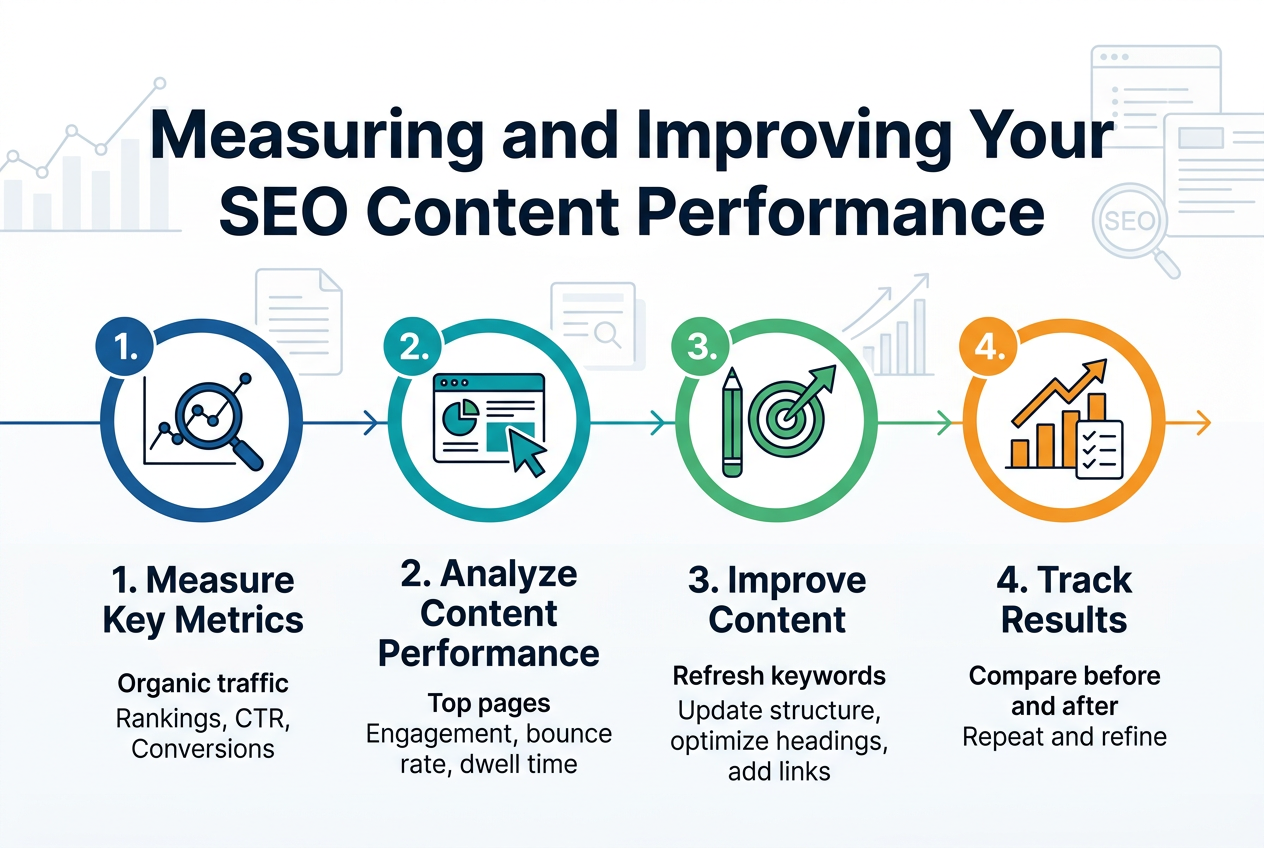
Keeping an eye on where your pages actually rank is one of the most practical ways to grow your SEO content strategy. Without tracking, you’re essentially flying blind — publishing content and hoping something sticks.
Tools Worth Using
Here are some go-to tools that make measuring SEO performance straightforward:
- Google Search Console – Free, reliable, and directly connected to Google’s data. You can see which queries bring people to your site, your average position, and click-through rates.
- Ahrefs or Semrush – Paid tools that give you a deeper look at keyword movements, competitor rankings, and backlink profiles.
- Google Analytics 4 – Pairs well with Search Console to show you what users do after they land on your page.
What to Actually Look For
Ranking data becomes useful when you know what signals to pay attention to:
| Signal | What It Tells You |
|---|---|
| Pages ranking on page 2 (positions 11–20) | Low-hanging fruit — a few tweaks could push them to page 1 |
| High impressions, low clicks | Your title or meta description needs work |
| Steady ranking drops | Content may be outdated or losing authority |
| New rankings for long-tail keywords | Your content is expanding its reach naturally |
Pages sitting in positions 11 through 20 deserve special attention. These are your biggest growth opportunities. With some targeted updates — adding more depth, refining on-page SEO optimization, or building a few quality backlinks — you can often move them onto the first page without starting from scratch.
Also watch for pages that get a ton of impressions but very few clicks. That gap almost always points to a weak title tag or a meta description that doesn’t connect with what the searcher actually wants. Rewriting those elements alone can noticeably lift your traffic without touching the body content.
Set a habit of reviewing your rankings at least once a month. Look for trends, not just individual snapshots. A page that ranks at position 8 one week but drops to 22 the next is telling you something — maybe a competitor published stronger content, or Google updated how it evaluates your topic.
Analyze Bounce Rates to Improve Content Quality
A high bounce rate is often misread as a bad thing across the board, but the real story depends on context. Someone who lands on your page, reads the entire article, and leaves satisfied will still technically count as a bounce in traditional analytics. That said, when bounce rates are high and your average session duration is low, that’s a genuine red flag worth digging into.
What a High Bounce Rate Usually Means
When people leave your page quickly, a few things are typically going on:
- Content doesn’t match search intent – Someone searched for “how to write SEO content” and landed on a page selling SEO services. Mismatch. They’re gone in seconds.
- Slow page load speed – People won’t wait. If your page takes more than three seconds to load, a significant chunk of visitors will leave before they even see your content.
- Hard-to-read formatting – Giant walls of text, tiny fonts, or no clear structure make readers bounce fast.
- The content doesn’t deliver on its promise – Your headline sets expectations. If your article doesn’t back it up with real, useful information, readers figure that out quickly.
How to Actually Fix It
Rather than obsessing over the bounce rate number itself, focus on making your content genuinely better for the person reading it.
Match content to search intent: Before publishing or updating a piece, search your target keyword yourself. Look at what Google is already ranking on page one. Those results tell you exactly what format and depth searchers are looking for.
Improve your content structure: Break things up with clear subheadings, bullet points, and short paragraphs. Make it easy for someone to skim and still get value — because most people do skim first before committing to a full read.
Add internal links strategically: When someone finishes reading one section, a relevant internal link gives them somewhere natural to go next. This keeps them on your site longer and signals to Google that your content ecosystem is well-connected.
Update stale content regularly: One of the easiest wins in any SEO content strategy is revisiting older posts. Outdated stats, broken links, or thin sections drag down your content authority. Refreshing them with current data, better examples, and expanded coverage can turn a mediocre page into one that consistently ranks on Google.
A Simple Content Audit Framework
Use this checklist when reviewing underperforming pages:
- Does the content match the search intent of the primary keyword?
- Is the page loading in under three seconds on mobile?
- Are there clear subheadings that guide the reader through the content?
- Is the introduction compelling enough to make someone want to keep reading?
- Does the content answer the question better than the top three competing pages?
- Are there internal links pointing to related, relevant content?
- Has the content been updated within the last 12 months?
Checking these boxes consistently is what separates content that quietly collects dust from search engine optimized writing that builds real, compounding traffic over time.
Creating SEO-friendly content is not just about stuffing keywords into a page — it is about finding the right balance between what search engines want and what your readers actually enjoy. From doing solid keyword research to optimizing your on-page elements, every step plays a role in helping your content show up in front of the right people at the right time. Building authority and trust around your content takes time, but when combined with tracking your performance and making smart adjustments, the results are absolutely worth it.
The good news is that you do not need to be a technical genius to make all of this work. Start small, focus on genuinely helping your audience, and keep refining your approach based on real data. The more consistently you apply these strategies, the better your content will perform over time. So pick one area to improve today and build from there — your rankings will thank you for it. You may as well visit garbiin.com for the latest Content Marketing articles.