

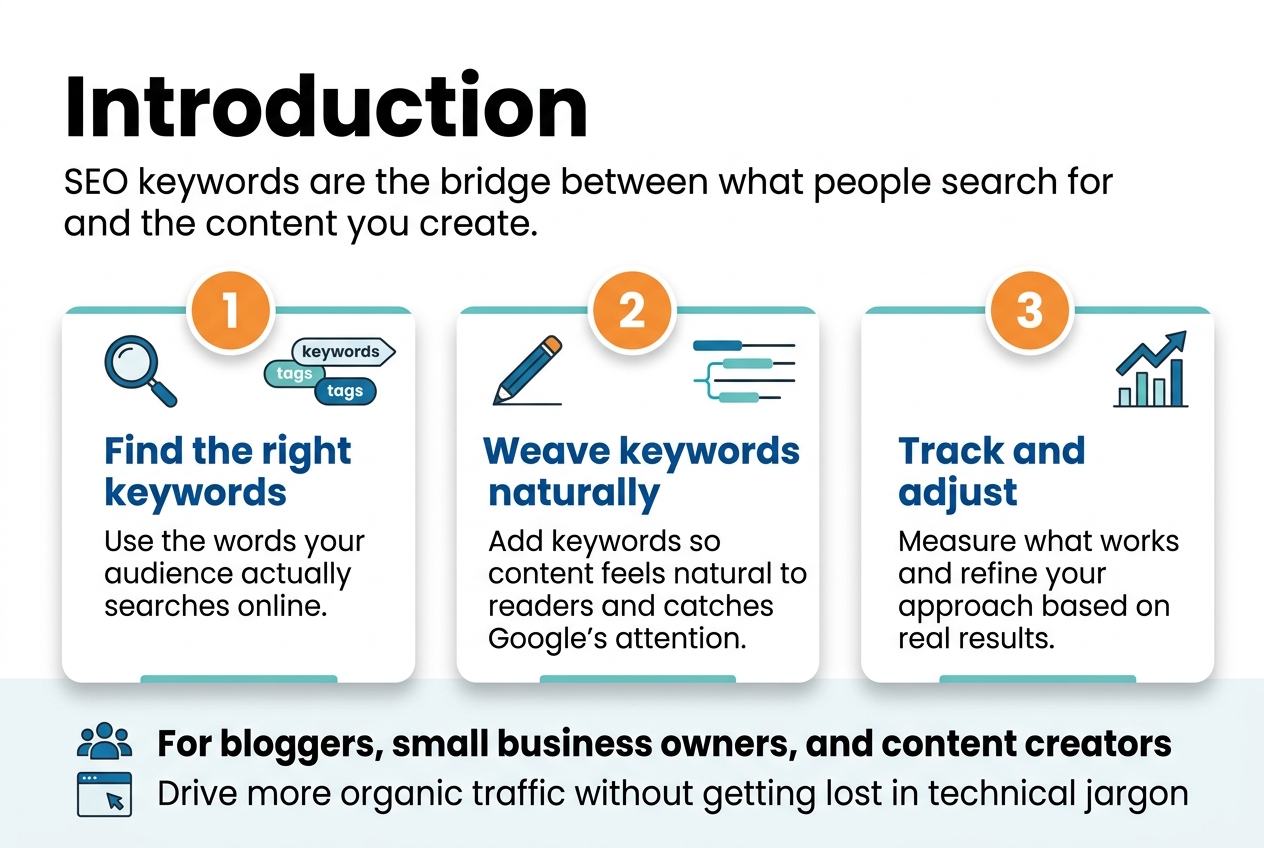
SEO keywords are the bridge between what people search for and the content you create. This guide is designed for bloggers, small business owners, and content creators who want to drive more organic traffic to their websites without getting lost in technical jargon.
You’ll learn how to find the right keywords that your audience actually uses when searching online. We’ll also walk you through smart ways to weave those keywords into your content so it feels natural to readers while still catching Google’s attention. Finally, you’ll discover simple methods to track what’s working and adjust your approach based on real results.
Master Keyword Research Fundamentals
Identify Your Target Audience’s Search Intent
Understanding what your audience actually wants when they type specific words into Google makes the difference between content that ranks and content that gets lost in the digital void. Search intent is the real reason behind every search query – the underlying motivation that drives someone to their keyboard.
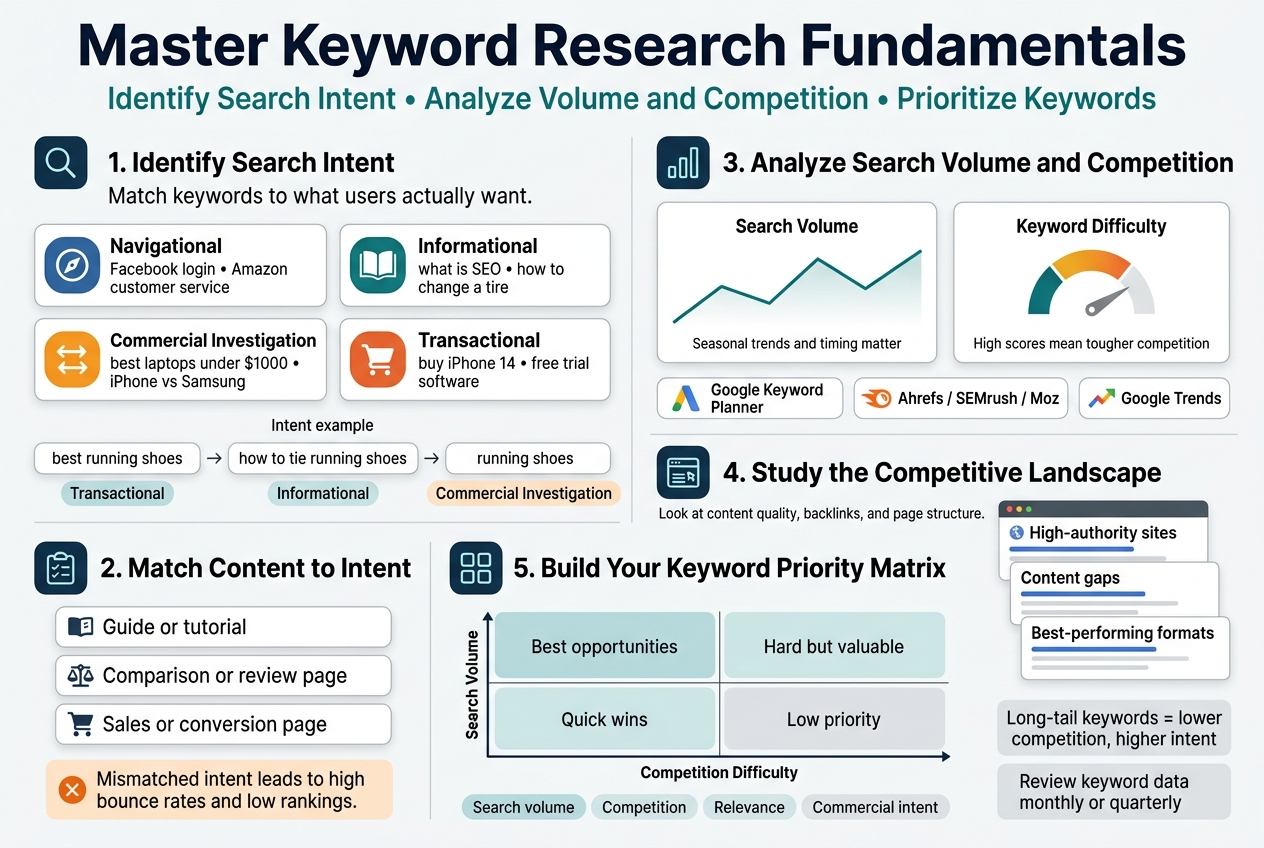
People don’t just randomly search for things. They have specific goals, problems to solve, or information they need. When someone searches for “best running shoes,” they’re probably ready to buy. When they search for “how to tie running shoes,” they need instructions. When they type “running shoes,” they might be browsing or comparing options. Each of these searches has completely different intent, and your keyword strategy needs to account for these differences.
The Four Core Types of Search Intent
Navigational intent happens when people know exactly where they want to go. They’re searching for a specific website, brand, or page. Think “Facebook login” or “Amazon customer service.” These searchers already have a destination in mind and are using Google as their GPS.
Informational intent drives the majority of searches. People want to learn something, answer a question, or understand a topic better. Searches like “what is SEO,” “how to change a tire,” or “symptoms of flu” all fall into this category. These users are in research mode, gathering knowledge before making decisions.
Commercial investigation intent sits between information gathering and purchasing. People are researching products or services they might buy, comparing options, reading reviews, or looking for the best deals. Searches like “best laptops under $1000,” “iPhone vs Samsung,” or “local restaurants near me” show this intent.
Transactional intent signals readiness to take action. These searchers want to buy, sign up, download, or complete some other conversion. Keywords like “buy iPhone 14,” “pizza delivery,” or “free trial software” indicate people ready to act.
Matching Content to Intent
Your content must align with the searcher’s intent, not just include their keywords. If someone searches “how to use email marketing,” they want a guide or tutorial, not a sales page for your email marketing software. Mismatching intent and content creates high bounce rates, poor user experience, and low rankings.
Google has become incredibly sophisticated at understanding intent. The search engine analyzes user behavior, click-through rates, time spent on pages, and countless other signals to determine which results best satisfy each type of intent. If your content doesn’t match what users actually want, Google notices and adjusts rankings accordingly.
Tools and Methods for Intent Research
Start by analyzing the current search results for your target keywords. Google’s results page tells a story about what users want. If the first page shows mostly blog posts and guides, the intent is informational. If you see product pages and shopping results, the intent is transactional. If review sites and comparison pages dominate, users are in commercial investigation mode.
Google’s autocomplete suggestions reveal related searches and common questions. Type your main keyword and see what Google suggests. These suggestions come from real user data and show you what people actually search for related to your topic.
The “People Also Ask” section provides goldmine insights into user questions and concerns. These expandable questions show you exactly what information people seek around your topic. Use these questions to understand the full scope of what your audience wants to know.
Google Search Console data reveals the actual queries bringing people to your site. Look at the search terms in your performance reports to understand what intent your existing content satisfies and where gaps might exist.
Social media platforms and forums like Reddit, Quora, and industry-specific communities show you the real language people use and the questions they ask. These platforms reveal pain points, common misconceptions, and the natural way people discuss your topic.
Creating Intent-Based Keyword Lists
Organize your keywords by intent type to create more targeted content strategies. Build separate lists for informational, commercial, and transactional keywords related to your business. This organization helps you plan content that serves users at different stages of their journey.
Map keywords to the customer journey. Awareness stage keywords tend to be informational (“what is digital marketing”). Consideration stage keywords often show commercial intent (“best email marketing tools”). Decision stage keywords are typically transactional (“buy Mailchimp subscription”).
Long-tail keywords often reveal more specific intent than broad terms. “Running shoes” could mean anything, but “waterproof trail running shoes for women” shows very specific intent. These longer, more specific phrases often convert better because they match exactly what someone wants.
Analyze Search Volume and Competition Levels
Raw search volume numbers can be misleading without context. A keyword with 10,000 monthly searches might seem attractive, but if it’s dominated by major brands with massive budgets, breaking through becomes nearly impossible. Smart keyword analysis balances opportunity against reality.
Search volume represents the average number of searches per month for a specific keyword. But these numbers fluctuate based on seasonality, trends, and external events. “Christmas gifts” peaks in December but stays low most of the year. “Tax software” surges in early spring. Understanding these patterns helps you plan content timing and resource allocation.
Understanding Keyword Difficulty Metrics
Keyword difficulty scores attempt to quantify how hard it would be to rank on the first page for a specific term. Different tools use different scales and methodologies, but they all analyze similar factors: the authority of currently ranking pages, the number of referring domains, content quality, and on-page optimization.
High difficulty scores don’t automatically mean you should avoid a keyword. If you have strong domain authority, excellent content, and a solid backlink profile, you might compete effectively even for difficult terms. Conversely, newer websites often need to start with easier keywords to build authority gradually.
Competition levels vary dramatically between industries. Legal and financial keywords typically show intense competition because the commercial value is enormous. Niche hobby topics might have lower competition but also lower search volume. Finding the sweet spot requires understanding your specific market dynamics.
Tools for Volume and Competition Analysis
Google Keyword Planner provides data straight from Google, making it the most reliable source for search volume estimates. The tool shows average monthly searches, competition levels for ads, and suggested bid prices. Higher suggested bids often indicate higher commercial value and more competition.
Third-party tools like Ahrefs, SEMrush, and Moz offer more detailed keyword analysis. These platforms provide keyword difficulty scores, SERP analysis, and competitor insights that Keyword Planner doesn’t offer. They also show related keywords and content gaps you might exploit.
Google Trends reveals search volume patterns over time and geographic distribution. This tool helps you understand whether interest in your keywords is growing, declining, or seasonal. Regional data shows where your keywords are most popular, which can inform content localization strategies.
Competitive Landscape Analysis
Study the websites currently ranking for your target keywords. Look at their domain authority, content quality, page structure, and backlink profiles. If the first page is dominated by high-authority sites with comprehensive, well-optimized content, you’ll need to create something even better to compete.
Analyze the content gaps in current results. Maybe all the ranking pages focus on one aspect of a topic while ignoring other important angles. These gaps represent opportunities to create more comprehensive, useful content that better serves user intent.
Look at the content formats performing well. Are the top results long-form guides, quick tips, videos, or product pages? The format that dominates rankings often indicates what users prefer for that particular search query.
Balancing Opportunity and Difficulty
Target a mix of high-volume competitive keywords and lower-volume easier keywords. The competitive keywords might take months or years to rank for, but they offer significant traffic potential. Easier keywords can drive immediate traffic and help build topical authority.
Consider your timeline and resources. If you need quick wins, focus on lower-competition keywords first. If you’re building long-term organic growth, investing in some competitive keywords makes sense, even if results take time.
Seasonal and Trending Considerations
Many keywords show predictable seasonal patterns. “Halloween costumes” peaks in October, “tax preparation” surges in spring, and “vacation destinations” might spike in winter and spring as people plan summer trips. Plan your content calendar around these patterns to maximize impact.
Breaking news and trending topics can create temporary keyword opportunities. Tools like Google Trends and social media monitoring help you identify emerging topics before they become saturated with content. Moving quickly on trend-based keywords can capture significant traffic before competition intensifies.
Long-tail Keyword Strategy
Long-tail keywords typically show lower search volume but also face less competition. “Digital marketing” might have 100,000 monthly searches but intense competition. “Digital marketing for small law firms” might have only 500 searches but could be much easier to rank for and more likely to convert.
These specific phrases often indicate higher purchase intent. Someone searching for “best CRM software for real estate agents under $100” is much closer to buying than someone searching for “CRM software.” Target long-tail variations of your main keywords to capture these high-intent searchers.
Building Your Keyword Priority Matrix
Create a simple scoring system that weighs search volume, competition level, relevance to your business, and commercial intent. This matrix helps you prioritize which keywords deserve immediate attention and which can wait.
Plot keywords on a graph with search volume on one axis and competition difficulty on the other. Keywords in the high volume, low competition quadrant represent your best opportunities. Keywords in the low volume, high competition quadrant probably aren’t worth pursuing unless they’re extremely relevant to your business.
Regular keyword analysis keeps your strategy current. Search trends change, new competitors enter the market, and Google’s algorithm evolves. Monthly or quarterly keyword reviews help you adapt your strategy and identify new opportunities as they emerge.
Optimize Your Content Structure for Maximum Impact
Place Primary Keywords in Title Tags and Headlines
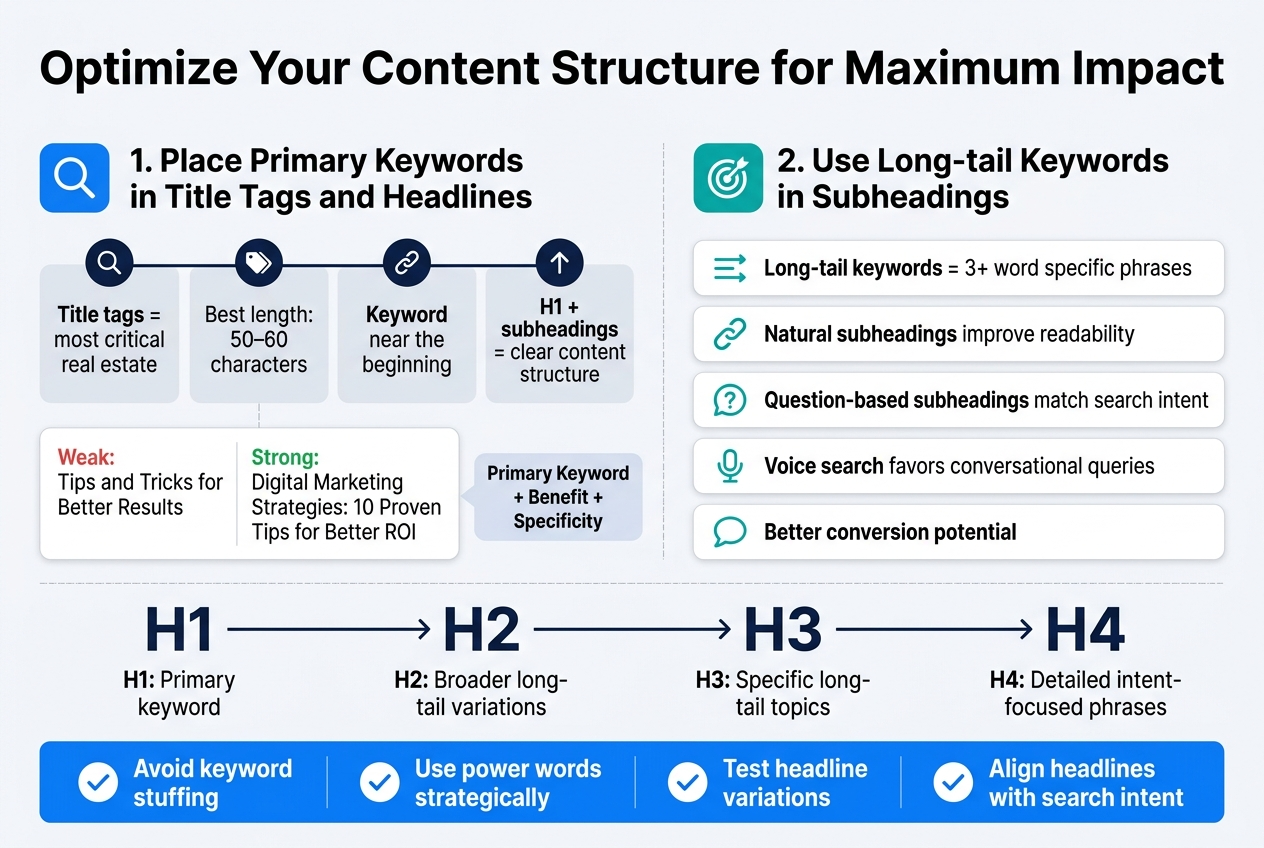
Your title tags and headlines act as the gateway to your content, making them the most critical real estate for your primary keywords. Search engines place enormous weight on these elements, viewing them as strong signals about your page’s main topic and relevance.
Title tags deserve special attention because they serve dual purposes. They communicate directly with search engine crawlers while also appearing as the clickable headline in search results. When someone searches for “digital marketing strategies,” and your title tag contains that exact phrase, you’re sending a clear signal that your content addresses their query.
The sweet spot for title tag length sits between 50-60 characters. This ensures your full title displays in search results without getting cut off. Cramming keywords beyond this limit often backfires, as truncated titles look unprofessional and may hurt click-through rates. Your primary keyword should appear as close to the beginning of the title as possible while maintaining natural readability.
Here’s what effective title tag optimization looks like in practice:
Weak Example: “Tips and Tricks for Better Results”
Strong Example: “Digital Marketing Strategies: 10 Proven Tips for Better ROI”
The stronger example immediately identifies the primary keyword (“digital marketing strategies”) while promising specific value. It follows the power formula of Primary Keyword + Benefit + Specificity.
Headlines within your content follow similar principles but with more flexibility. Your H1 tag typically mirrors your title tag, though it can be slightly longer since it doesn’t face the same display constraints. This headline should contain your primary keyword and clearly communicate what readers will learn or accomplish.
Subheadings (H2, H3, etc.) provide excellent opportunities to incorporate keyword variations and related terms. These elements help search engines understand your content’s structure while making it more scannable for readers. Think of your heading hierarchy as a roadmap that guides both users and crawlers through your content.
Consider this heading structure for a post about “content marketing best practices”:
- H1: Content Marketing Best Practices: A Complete Guide for 2024
- H2: Why Content Marketing Best Practices Matter for Your Business
- H3: Audience Research Strategies
- H3: Content Planning and Editorial Calendars
- H2: Advanced Content Marketing Techniques
- H3: Repurposing Content Across Multiple Channels
- H3: Measuring Content Performance
Each heading incorporates relevant keywords while maintaining a logical flow. The H1 contains the primary keyword, H2s include variations like “content marketing techniques,” and H3s target more specific, long-tail variations.
Avoid keyword stuffing in your headlines. Search engines have become sophisticated at detecting unnatural keyword density, and readers immediately recognize when headlines feel forced or awkward. Your headlines should read naturally while incorporating your target keywords strategically.
The psychological aspect of headlines can’t be ignored either. Numbers, action words, and benefit-driven language increase engagement rates. Headlines that promise specific outcomes (“10 Content Marketing Best Practices That Drive Results”) typically outperform generic ones (“Content Marketing Tips”).
Power words enhance your headlines without compromising keyword placement. Words like “ultimate,” “essential,” “proven,” “complete,” and “definitive” add authority and appeal. However, use them strategically rather than stuffing multiple power words into every headline.
Testing different headline variations can reveal what resonates with your audience. Tools like Google Search Console show which headlines generate higher click-through rates, providing valuable data for refining your approach. Sometimes a minor tweak in keyword placement or phrasing can significantly impact performance.
Your headlines also need to align with search intent. Someone searching “how to create content marketing strategy” wants actionable guidance, not theoretical concepts. Your headline should promise and deliver practical steps: “How to Create a Content Marketing Strategy: 7-Step Blueprint.”
Use Long-tail Keywords in Subheadings
Long-tail keywords represent the goldmine of SEO opportunities that many content creators overlook. These longer, more specific phrases typically face less competition while targeting users with clearer intent. When strategically placed in subheadings, they create multiple pathways for your content to rank for various related searches.
Long-tail keywords usually contain three or more words and represent more specific queries. Instead of targeting the broad term “email marketing,” you might focus on “email marketing automation tools for small businesses” or “how to improve email open rates for ecommerce.” These phrases attract more qualified traffic because they match specific user needs.
Subheadings provide perfect placement opportunities for these longer phrases. Unlike title tags with character limitations, subheadings can accommodate more descriptive language while maintaining readability. This flexibility lets you target multiple long-tail variations within a single piece of content.
The strategic advantage of long-tail keywords in subheadings becomes clear when you consider search behavior. Users often refine their searches progressively, starting broad and becoming more specific. Someone might search “social media marketing,” then “Instagram marketing for restaurants,” then “Instagram story templates for restaurant promotions.” Your subheadings can capture traffic at various stages of this search journey.
Research shows that long-tail keywords convert better because they indicate stronger purchase intent. Someone searching “best CRM software” might be in early research mode, but someone searching “affordable CRM software for real estate agents with email automation” is likely closer to making a decision. Your subheadings should reflect this intent matching.
Here’s how to effectively incorporate long-tail keywords into your subheading strategy:
Research Phase: Start with your primary keyword and use tools to identify related long-tail variations. Google’s “People Also Ask” section provides excellent long-tail keyword ideas that directly reflect user questions. Answer The Public generates question-based long-tail keywords that work perfectly as subheadings.
Natural Integration: Your long-tail keywords should fit naturally into your content flow. Forced or awkward subheadings hurt user experience and may trigger search engine penalties. Instead of “Best Email Marketing Tools Small Business Budget-Friendly Options,” try “Best Budget-Friendly Email Marketing Tools for Small Businesses.”
Question-Based Subheadings: Many long-tail keywords take the form of questions. These work exceptionally well as subheadings because they directly address user queries. “What Are the Most Effective Social Media Platforms for B2B Marketing?” captures a specific long-tail keyword while promising direct answers.
Geographic Targeting: Location-based long-tail keywords in subheadings can capture local search traffic. “Digital Marketing Strategies for Austin Small Businesses” targets users in a specific geographic area with particular needs.
The hierarchy of your subheadings should reflect the relationship between your keywords. Your H2 subheadings might target broader long-tail keywords, while H3 and H4 subheadings focus on more specific variations:
- H2: Email Marketing Automation Best Practices
- H3: How to Set Up Automated Welcome Email Sequences
- H4: Welcome Email Templates for SaaS Companies
- H4: Timing Your Automated Welcome Emails for Maximum Impact
This structure creates a comprehensive keyword net that captures traffic for various related searches while maintaining logical content organization.
Long-tail keywords in subheadings also support featured snippet optimization. Google often pulls subheadings and their accompanying content for featured snippet displays. By targeting question-based long-tail keywords in your subheadings and providing clear, concise answers immediately afterward, you increase your chances of earning these prominent SERP positions.
Voice search optimization represents another compelling reason to focus on long-tail keywords in subheadings. Voice queries tend to be longer and more conversational than typed searches. Someone might type “pizza recipe,” but they’d ask their voice assistant, “How do I make homemade pizza dough without yeast?” Your subheadings should anticipate and address these natural language queries.
The semantic relationship between your long-tail keywords matters tremendously. Search engines understand topical relevance, so your subheadings should cover related concepts comprehensively. For content about “email marketing,” your subheadings might include long-tail keywords about email automation, list building, deliverability, analytics, and personalization.
Content clusters benefit significantly from strategic long-tail keyword placement in subheadings. Each piece of content in your cluster should target different long-tail variations while linking back to your pillar content. This approach establishes topical authority and improves rankings for the entire keyword family.
Monitoring performance for your long-tail keyword subheadings reveals valuable insights about user behavior and content effectiveness. Google Search Console shows which specific queries bring users to your content, helping you identify successful long-tail keywords and opportunities for expansion.
The competitive landscape for long-tail keywords often favors well-optimized content over domain authority. A smaller website with precisely targeted long-tail keywords in strategic subheadings can outrank larger competitors who focus only on broad terms. This levels the playing field and creates opportunities for newer websites to establish search visibility.
Seasonal and trending long-tail keywords in subheadings can capture timely traffic. “Black Friday email marketing campaigns for small retailers” targets a specific time-sensitive query that users actively search during certain periods. Your content calendar should incorporate these temporal long-tail opportunities.
The relationship between user experience and long-tail keyword optimization in subheadings creates a virtuous cycle. Well-structured subheadings improve readability and engagement, which send positive signals to search engines. Users spend more time on pages with clear, keyword-optimized subheadings that help them find specific information quickly.
Cross-referencing your long-tail keywords with competitor analysis reveals gaps and opportunities. Tools like SEMrush or Ahrefs show which long-tail keywords your competitors target in their subheadings, helping you identify untapped opportunities or areas where you can provide better coverage.
Implement Strategic Keyword Placement Techniques
Optimize Meta Descriptions for Click-Through Rates
Meta descriptions work like movie trailers for your web pages. They give searchers a sneak peek of what they’ll find when they click through to your content. While meta descriptions don’t directly impact your search rankings, they play a massive role in whether people actually visit your site after finding it in search results.
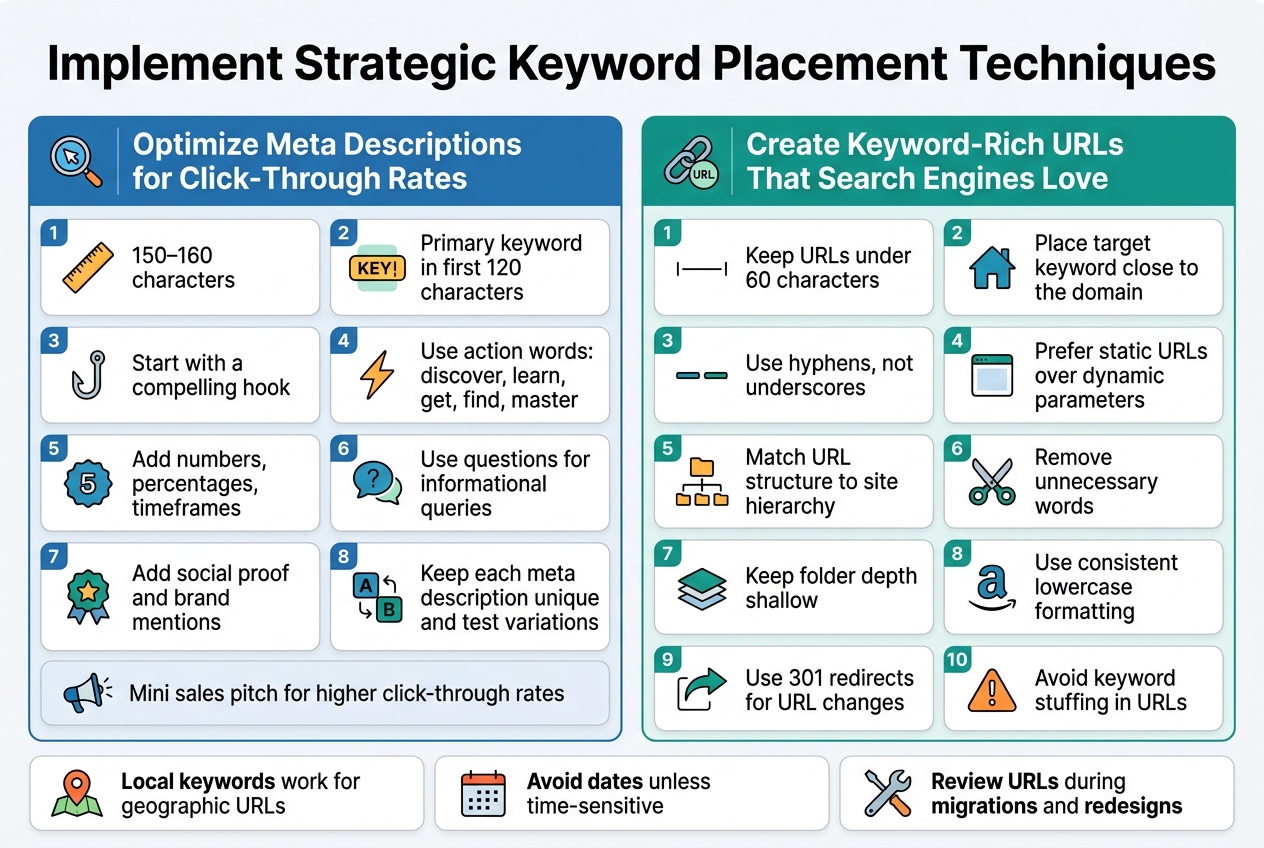
The sweet spot for meta description length sits between 150-160 characters. Google typically displays about this much text before cutting it off with an ellipsis. Going over this limit means your carefully crafted message gets truncated, potentially losing its persuasive power right when you need it most.
Your primary keyword should appear naturally within the first 120 characters of your meta description. This early placement serves two purposes: it gets highlighted in bold when it matches the searcher’s query, and it survives any potential truncation on mobile devices or different search result layouts.
Think of your meta description as a mini sales pitch. You have just a few seconds to convince someone scrolling through search results that your page deserves their click. Start with a compelling hook that directly addresses what the searcher wants to know or accomplish.
Action-oriented language works exceptionally well in meta descriptions. Words like “discover,” “learn,” “get,” “find,” and “master” create a sense of forward momentum. Instead of writing “This page contains information about keyword research,” try “Discover the exact keyword research process that drives 10x more traffic to your site.”
Including specific numbers, percentages, or timeframes adds credibility and sets clear expectations. “5 proven strategies,” “increase traffic by 300%,” or “in just 15 minutes” give searchers concrete details about what they’ll gain from clicking through.
Question-based meta descriptions can work particularly well for informational queries. If someone searches “how to choose keywords,” a meta description starting with “Struggling to pick the right keywords for your content?” immediately creates a connection with their current challenge.
Social proof elements like “used by 50,000+ marketers” or “featured in Forbes” can significantly boost click-through rates, especially for competitive keywords where multiple high-quality results appear on the same search page.
Each page on your website needs a unique meta description. Duplicate meta descriptions confuse search engines and waste opportunities to target different keyword variations and user intents. Even similar pages should have distinct descriptions that highlight their specific focus or angle.
Emotional triggers work surprisingly well in meta descriptions. Words that evoke curiosity (“secret,” “hidden,” “surprising”), urgency (“today,” “now,” “before it’s too late”), or exclusivity (“insider,” “advanced,” “professional”) can increase click-through rates when used appropriately.
Brand mentions in meta descriptions can build trust, especially for lesser-known websites. If you’ve been featured in recognizable publications or work with well-known clients, including these details can provide the credibility boost needed to win clicks from cautious searchers.
Testing different meta descriptions for your most important pages can reveal surprising insights about what resonates with your audience. Small changes in wording, structure, or emphasis can lead to significant improvements in click-through rates and overall organic traffic.
Create Keyword-Rich URLs That Search Engines Love
URL structure might seem like a technical afterthought, but it’s actually one of your most powerful on-page SEO tools. Clean, keyword-rich URLs help search engines understand your content before they even crawl the page, and they give users clear expectations about what they’ll find.
Short URLs consistently outperform long ones in search results. Aim for URLs under 60 characters when possible. This length ensures your full URL displays in search results without truncation and makes sharing easier across social media platforms where character limits matter.
Your target keyword should appear as close to the domain name as possible within the URL structure. Instead of /blog/2024/march/15/how-to-do-keyword-research-for-beginners-complete-guide/, use /keyword-research-guide/. The cleaner version is easier for both users and search engines to process.
Hyphens work better than underscores for separating words in URLs. Search engines treat hyphens as spaces, making it easier for them to parse individual words within your URL. While underscores technically work, hyphens have become the established best practice across the web.
Static URLs perform better than dynamic ones filled with parameters, session IDs, or tracking codes. A URL like /seo-tips/ is infinitely more valuable than /page.php?id=1247&session=abc123&category=seo. Static URLs are easier to remember, share, and rank in search results.
Matching your URL structure to your site hierarchy creates logical organization that benefits both users and search engines. If you have a section about SEO tools, URLs like /seo-tools/keyword-planners/ and /seo-tools/rank-trackers/ clearly show the relationship between parent and child pages.
Avoid unnecessary words in URLs that don’t add semantic value. Articles, prepositions, and conjunctions (a, an, the, of, for, and, but) can usually be removed without losing meaning. /how-to-use-seo-keywords/ works just as well as /how-to-use-seo-keywords-for-better-rankings/ and takes up less space.
Keep your folder structure shallow when possible. URLs with too many subdirectories (/category/subcategory/sub-subcategory/page/) can dilute link equity and make your site architecture seem unnecessarily complex to search engines.
Consistency in URL formatting across your entire website creates a professional appearance and helps with technical SEO. If you use lowercase letters and hyphens for one section, maintain that pattern throughout your site rather than mixing different conventions.
Redirects become necessary when you change URLs, but they should be 301 redirects (permanent) rather than 302 redirects (temporary). This passes the SEO value from your old URL to your new one, preserving any rankings and link equity you’ve built up over time.
Keyword stuffing in URLs backfires just like it does in content. A URL like /best-seo-keywords-seo-keyword-research-seo-tools/ looks spammy and provides no additional ranking benefit over a cleaner version like /seo-keyword-research-tools/.
Consider user experience when crafting URLs. A person should be able to look at your URL and have a clear idea of what they’ll find on the page. This transparency builds trust and can improve click-through rates when your URLs appear in search results or when people share them.
Geographic keywords in URLs work particularly well for local businesses. A URL like /chicago-plumber/ immediately signals both location and service to search engines and users. This geographic specificity helps with local search visibility and user relevance.
Seasonal or time-sensitive content should avoid dates in URLs unless the information is specifically tied to that time period. A URL like /2024-seo-trends/ will feel outdated quickly, while /current-seo-trends/ can be updated without changing the URL structure.
E-commerce sites benefit from including product attributes in URLs when they help with keyword targeting. A URL like /red-leather-boots-women/ targets multiple relevant keywords while clearly describing the product category.
Review and optimize your URL structure during site migrations or redesigns. This presents an opportunity to fix problematic URLs that may have developed over time and implement a cleaner, more SEO-friendly structure moving forward.
Remember that changing established URLs can temporarily impact your search rankings, even with proper redirects in place. Plan URL changes strategically and avoid making unnecessary modifications to URLs that already perform well in search results.
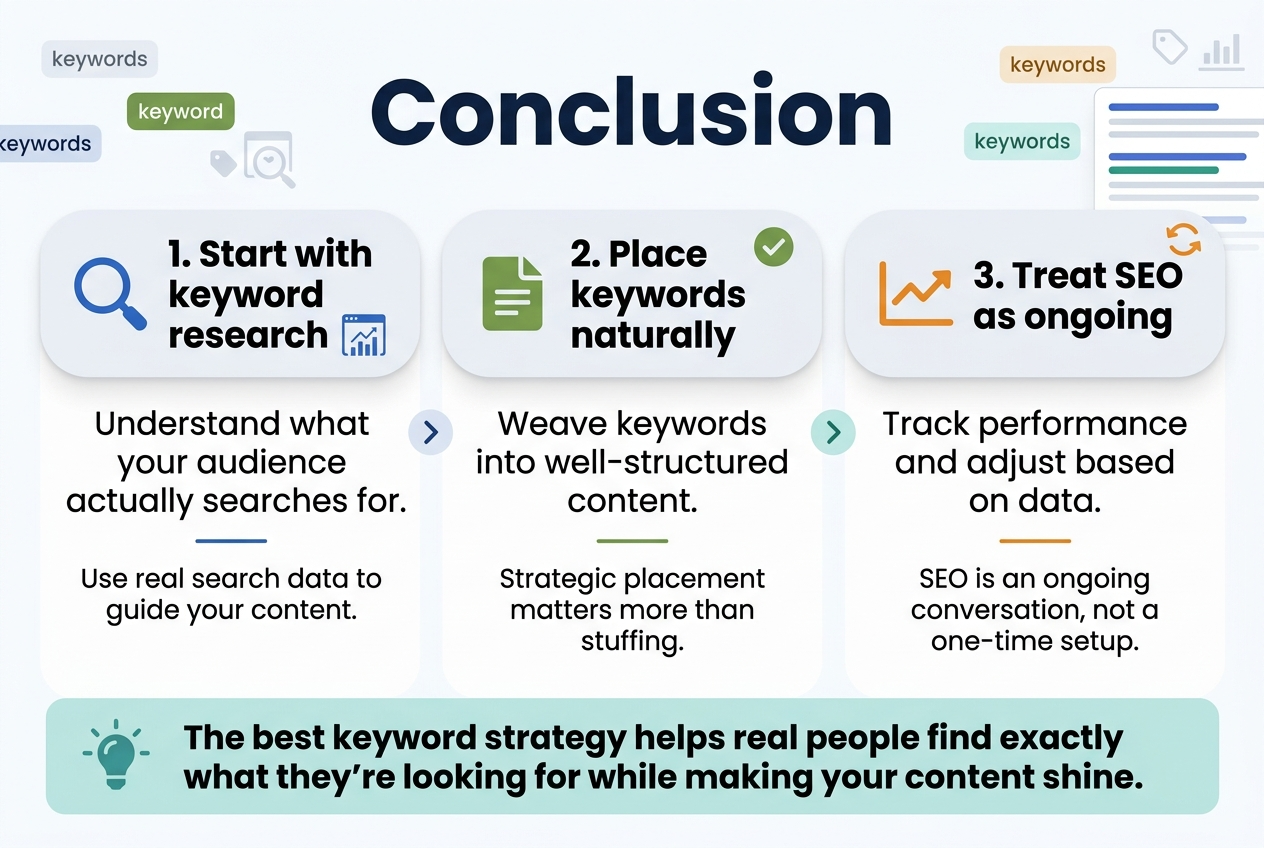
Getting your SEO keywords right doesn’t have to feel like solving a puzzle. Start with solid keyword research to understand what your audience actually searches for, then weave those terms naturally into well-structured content. The magic happens when you place keywords strategically without stuffing them everywhere – your readers and search engines will both thank you for it.
The real game-changer is treating SEO as an ongoing conversation, not a one-time setup. Keep an eye on how your keywords perform and adjust your approach based on what the data tells you. Remember, the best keyword strategy is one that helps real people find exactly what they’re looking for while making your content shine.

One Response